Heparin 20 days earlier+2 timing points
−20 days
Prior exposureDay 0
Restart≤1 day
Platelet fall
Prior exposureDay 0
Restart≤1 day
Platelet fall
Exposure within the preceding 30 days can support rapid-onset timing.
Four clinical domains. One transparent score. A structured starting point for HIT assessment.
Select one description in each domain. Start with the documented clinical facts.
Unanswered findings are not scored as zero.
Select the four domains to classify the assessment.
Peak 240 → nadir 90 ×10⁹/L · a 62.5% fall
Illustrative measurements only · not a real patient record.
| Clinical domain | Points |
|---|---|
| Thrombocytopenia | — |
| Timing | — |
| Thrombosis / sequelae | — |
| Other explanations | — |
| Total | Pending |
Confirm the relevant history before using a risk category. Missing information can change both the score and its interpretation.
Clinician-directed care only. Drug choice, dose and intensity require individual bleeding-risk, organ-function and treatment assessment.
Read the full ASH recommendations →A 2012 meta-analysis pooled 13 studies (3,068 people): low-score NPV 99.8% (95% CI 97–100%); intermediate-score PPV 14% (9–22%); high-score PPV 64% (40–82%). These are pooled study estimates, not a personalized probability. A high score alone does not confirm HIT.
Cuker et al., Blood, 2012

100 × (peak − nadir) / peak
Review the platelet peak around the relevant heparin course, the subsequent nadir and the onset of the decline. A substantial fall can occur while the count remains in the normal range. Scoring notes
For a platelet fall within 1 day, previous heparin exposure changes the timing-domain assessment.
Exposure within the preceding 30 days can support rapid-onset timing.
A rapid fall with exposure more than 30 to 100 days earlier receives 1 point.
An early fall by day 4 without recent exposure receives 0 timing points.
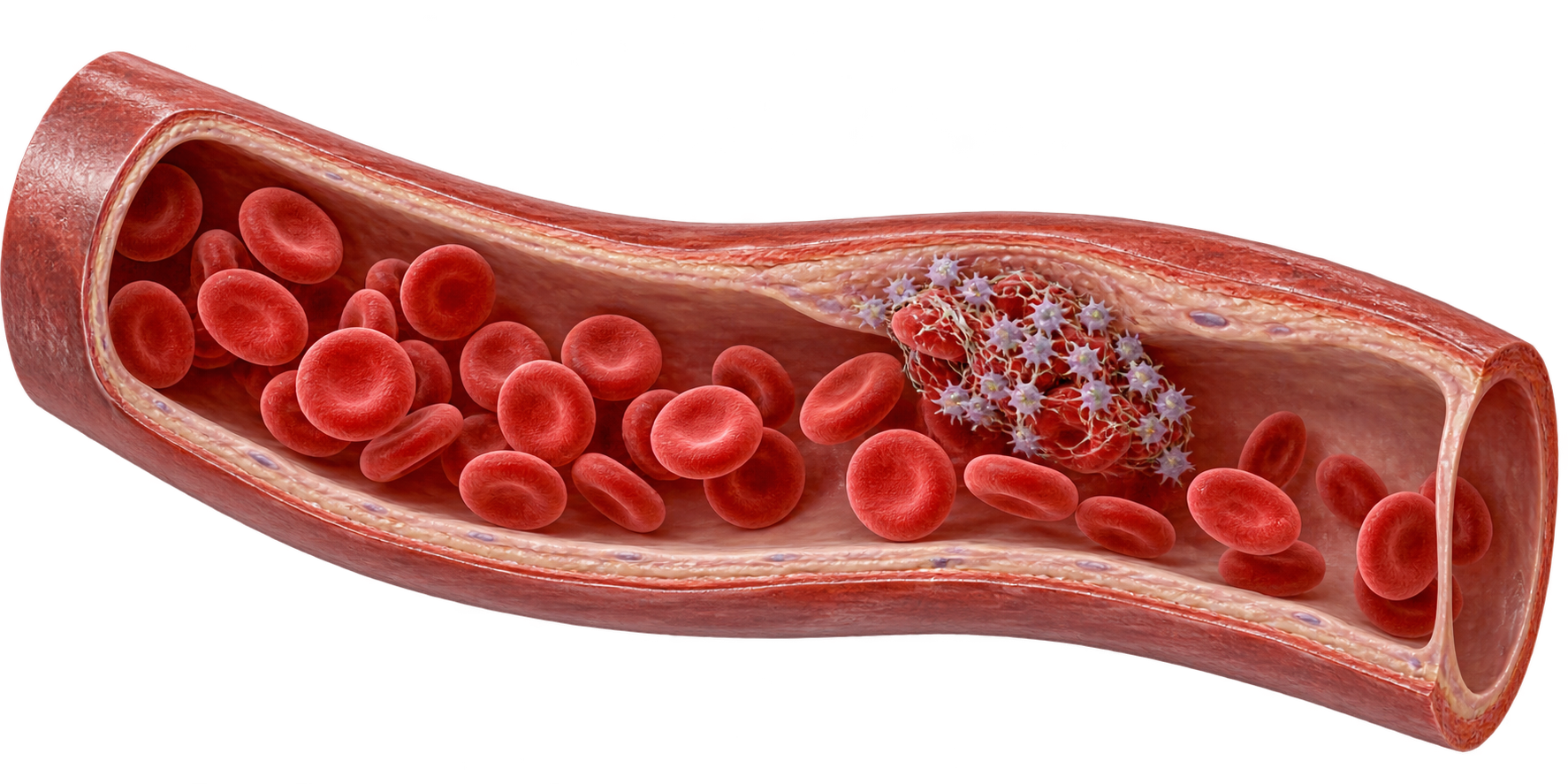 Medical illustration · not a microscope image · not to scale
Immune HIT involves platelet activation triggered by antibodies against PF4–heparin complexes. Platelet consumption can lower the count while thrombotic complications develop.
The score estimates clinical probability; laboratory evaluation helps establish the diagnosis.
Document the four domains and check the exposure timeline.
Intermediate/high probability generally prompts an anti-PF4/heparin immunoassay.
A positive immunoassay often needs a functional assay such as SRA, when available.
High clinical suspicion, assay strength and test availability may alter the sequence. This overview does not replace the full guideline.
Platelet fall >50%, nadir ≥20: 2 points.
Clear onset on day 7: 2 points.
Progressive thrombosis: 1 point.
Another cause is possible: 1 point.
2 + 2 + 1 + 1 = 6 / 8
High pre-test probability; not a confirmed diagnosis.
Example data are illustrative and should not be applied to a real patient.
Check heparin exposures in the previous 100 days, including prior admissions. Evaluate the start of a sustained decline, rather than only the day the count is lowest. Consider recent surgery, infection, disseminated intravascular coagulation, medications and mechanical support as competing explanations.
After cardiac surgery, a fall followed by recovery and a later second decline requires careful review. Recalculate the score when the clinical picture changes.
No. It indicates a high pre-test category and calls for prompt clinician assessment and appropriate laboratory evaluation.
Yes. The relative change matters. A large fall from a high peak can meet the decline criterion even when the current count remains within the reference range.
An unanswered question is not evidence that a finding is absent. The tool leaves the classification incomplete until all four domains have a documented selection.
This tool uses the conventional day 5–10 criteria in Cuker et al. (2012), including rapid-onset cases with recent exposure and early falls by day 4 without recent exposure. Some local tools use a different timing window; follow the protocol adopted by your service.
Seek the missing records and reassess. The “review needed” option is not scored as zero. If a provisional choice is necessary, mark the assessment uncertain and use clinical judgment.
No. Patients should contact the treating team. Any change to anticoagulation requires clinician supervision and consideration of bleeding and clotting risk.
No. It estimates the clinical probability of HIT. Bleeding risk and anticoagulant management are separate clinical assessments.
 ASH · HIT clinical guidelinesDiagnostic and initial management recommendations.May & Cuker · Practical Guide, 2024Scoring nuances and practical diagnostic context.
 Cuker et al. · Blood, 20124Ts definitions and predictive-value meta-analysis.
Independent references · Logos identify sources, not institutional endorsement. No specialist approval is claimed. Content basis checked 19 October 2026.
Four clinical domains. One transparent score. A structured starting point for HIT assessment.