

Age on Mercury Calculator
Discover your planetary age, next orbital birthday & place in the solar system.
Your Earth Baseline
Meet Mercury
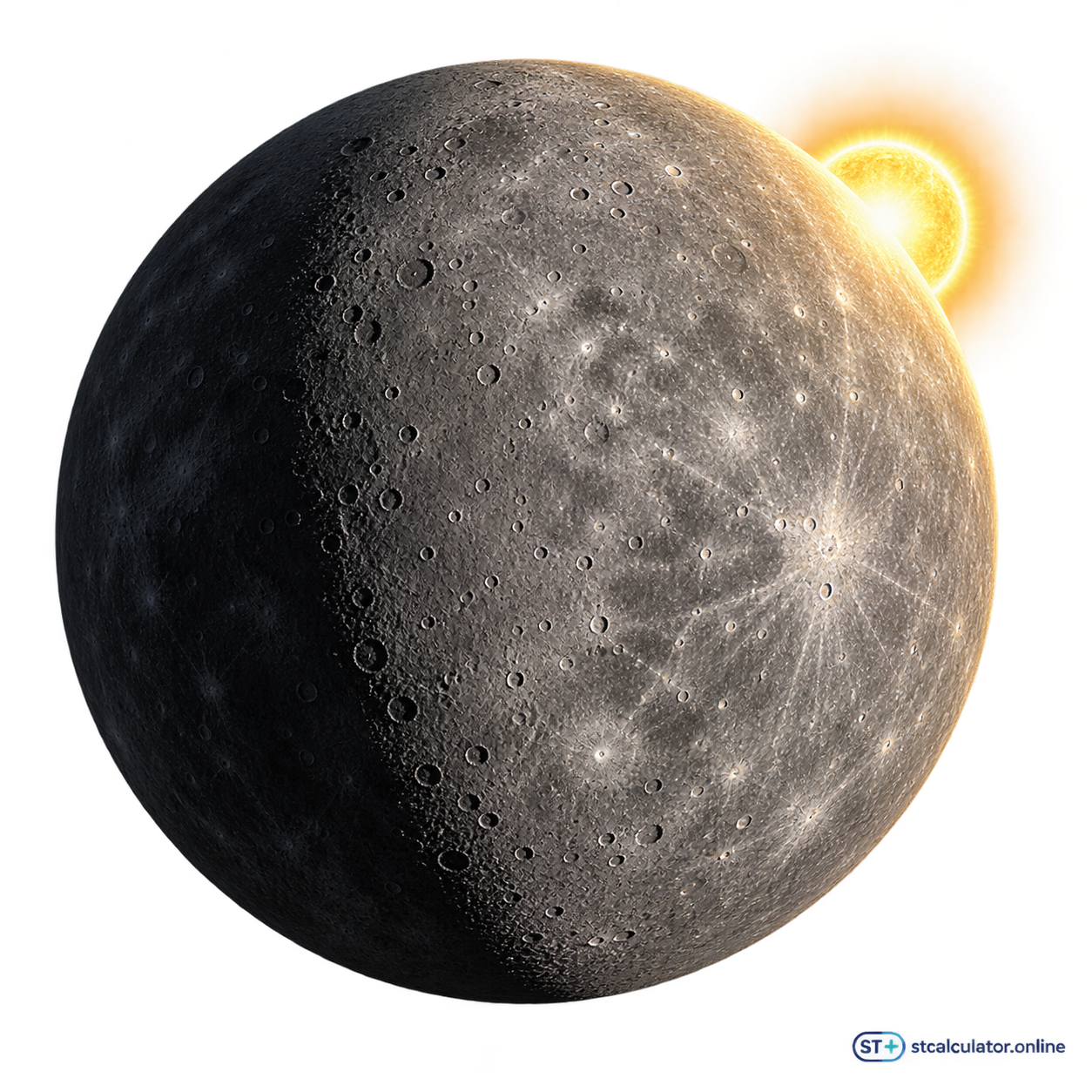

Your Mercury Age
Watch the years go by
Illustrative orbits — not current planetary positions or distances to scale.
Your next Mercury birthday
About 39 Earth daysA mean-period estimate; enter your birth date for a calendar date.
Your age across the solar system
A year is not the same as a day
Mercury’s sidereal rotation period.
Orbit and rotation combine to set the solar day.
Your mass stays the same; your weight changes.
Calculation & Worked Example
Planetary age = elapsed Earth days ÷ mean orbital period
Mean-period estimates, not an ephemeris. A calendar date rounds the orbital anniversary up to the next civil day.
Frequently Asked Questions
Why am I older on Mercury?
You have lived the same amount of time. A Mercury orbital year is shorter, so the same elapsed Earth days contain more Mercury years.
What is a Mercury birthday?
It is an estimated anniversary of each complete 87.969-day interval since your birth. It is not the date Mercury returns to a measured birth-position in its orbit.
Rotation vs solar day?
Mercury takes about 58.65 Earth days to spin relative to the stars. A solar day, from local noon to noon, lasts about 175.94 Earth days — roughly two Mercury years.
Can I explore other planets?
Yes. Choose a planet above or select one of the comparison cards. This changes the age result, orbital illustration and planetary facts within this Mercury page.
More questions
How does birth-date mode work?
The calculator counts calendar days from your birth date through the selected as-of date, using UTC civil-day arithmetic to avoid daylight-saving shifts. It does not know your exact birth time.
Why use 365.25 days for Earth age?
A numeric age is converted with a fixed Julian-year convention of 365.25 days. This differs from the tropical year, about 365.2422 days. Birth-date mode counts actual elapsed calendar days instead.
How accurate is the next birthday?
It assumes a constant mean orbital period. Orbital motion is not uniform and the illustration does not use an astronomical ephemeris. Dates are estimates, not exact planetary-return times.
Does traveling change my age?
Changing the year unit does not alter biological aging. Relativistic time dilation is outside this calculator.
Do I become lighter on Mercury?
Your mass in kilograms remains unchanged. Weight is the force caused by local gravity; Mercury’s surface gravity is about 38% of Earth’s.
What do giant-planet gravity figures mean?
Jupiter, Saturn, Uranus and Neptune have no ordinary solid surface to stand on. The displayed figures compare published equatorial gravity; rotation and solar-day values are approximate.
What happens on an exact orbital anniversary?
The completed-year count includes that anniversary. The next-birthday panel always shows the next strictly upcoming full orbital anniversary, not today’s anniversary.
What do the orbital controls do?
Play advances one illustrative Earth year in 20 seconds. Each planet advances according to its own orbital period. Pause stops motion and the slider lets you inspect it. Animations start paused and respect reduced-motion settings.
Sources & References
 NASASolar System Exploration · Mercury facts, orbit and day length
 JPL · CaltechSolar System Dynamics · Planetary physical parameters
Educational orbital-period estimates · Original illustrative planet art · No institutional endorsement.
Discover your age in Mercury years, your next estimated orbital birthday, and age comparisons across the solar system.