

Read & pre-clean
Use a product approved for the task. Remove visible soil before disinfection; follow rinsing directions.
Measure the bleach. Measure the water. Understand the dilution.
Calculated recipe · follow product-label directions.
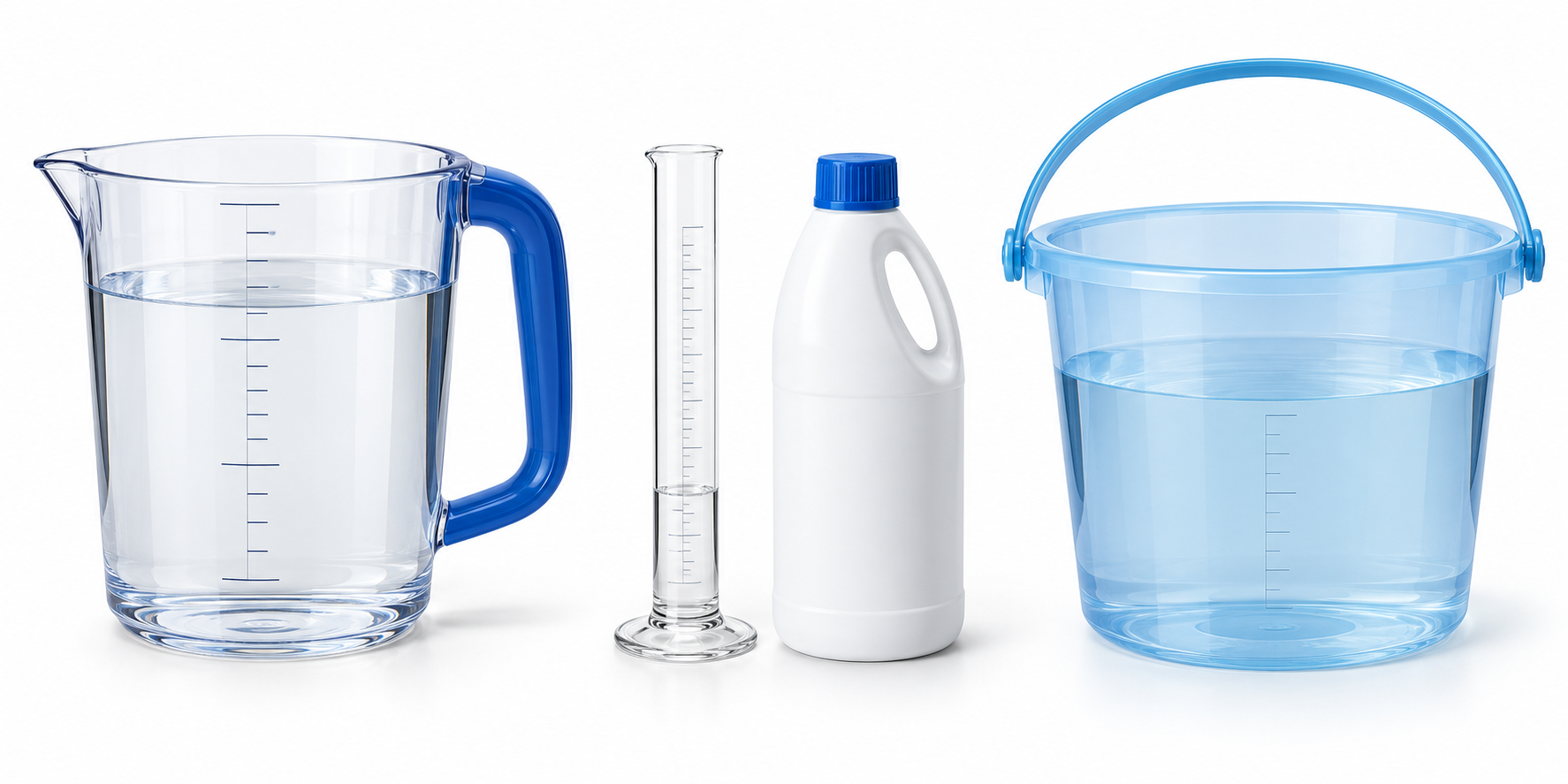
Glassware, liquid levels and color are illustrative. Use the calculated quantities, not the picture, for measurement.


| Surface / setting | Illustrative target | What to verify |
|---|---|---|
| Food-contact sanitizing | 100–200 ppm | Only an approved product/use. Follow label concentration, contact time and rinse directions. |
| Environmental surfaces | 1,000 ppm · 0.1% | WHO COVID-19 guidance example; check the organism, setting, surface and current local protocol. |
| Large blood / body-fluid spill | 5,000 ppm · 0.5% | WHO spill-guidance example. Requires the appropriate trained-staff procedure and PPE. |
These examples do not establish high-level disinfection, medical-device sterilization or suitability for every pathogen. Do not apply surface disinfectants to skin, food or animals.
Stock = 5.25% available chlorine = 52,500 mg/L
Target = 1,000 mg/L · Final volume = 1,000 mL
Bleach = 1,000 × 1,000 ÷ 52,500 = 19.05 mL
Water ≈ 1,000 − 19.05 = 980.95 mL
Uses a common available-chlorine basis, additive volumes and the supplied stock strength. It does not test actual chlorine content.
Select the ratio convention explicitly. Never guess which meaning a recipe uses.
Use a product approved for the task. Remove visible soil before disinfection; follow rinsing directions.
Use room-temperature water and label-required PPE. Add measured bleach to water without splashing.
Record strength and preparation date. Follow the label’s contact time, storage and solution-life instructions.
No. Mixing bleach with acids, ammonia or other cleaning products can release dangerous gases. Use it only as directed on the product label.
1% w/v equals 10,000 mg/L. This tool uses ppm as mg/L available chlorine. Strict mass-fraction ppm depends on the solution density; sodium-hypochlorite percentage and available-chlorine percentage are not interchangeable without checking their bases.
Check the product label. CDC household guidance uses regular unscented bleach with a stated sodium-hypochlorite strength, and warns that some laundry/splashless products are inappropriate for disinfection. Degradation can make the original strength unreliable.
No. The required concentration, wet contact time, surface compatibility and rinsing depend on the product and task. A stronger mixture can increase exposure and material-damage risks.
No. It calculates a dilution from supplied inputs. The product label and applicable protocol determine use instructions and wet contact time.
Handling reference: CCOHS · WHO technical guidance (2020)
Independent reference material · No institutional endorsement or product approval implied.
Measure the bleach. Measure the water. Understand the dilution.