

Blood Volume Calculator Adult Nadler estimate
Estimate total blood volume from height and weight. Follow the calculation.
Your Measurements
Illustrative equipment — enter your measurements.
What the Inputs Mean
Height
Converted from centimetres to metres for h³.
Weight
Entered in kilograms.
Equation profile
Chooses the male or female Nadler coefficients.
Use the Right Inputs
- This is an adult estimation formula.
- Keep height and weight units consistent.
- Body composition and clinical conditions can affect accuracy.
Your Estimated Blood Volume
Calculated estimate · rounded to 2 decimals.
Both volume displays are rounded from the same unrounded estimate.
Follow the Estimate
Convert height to metres
Apply the selected Nadler equation
Read the estimated volume
Unrounded arithmetic is retained internally; this is still an estimate.
Clinical equipment to measure height and weight.

Clinician reviewing or recording measurements.
A Closer Look at the Measurements

Record height
Measure height with a stadiometer, without shoes, standing upright.
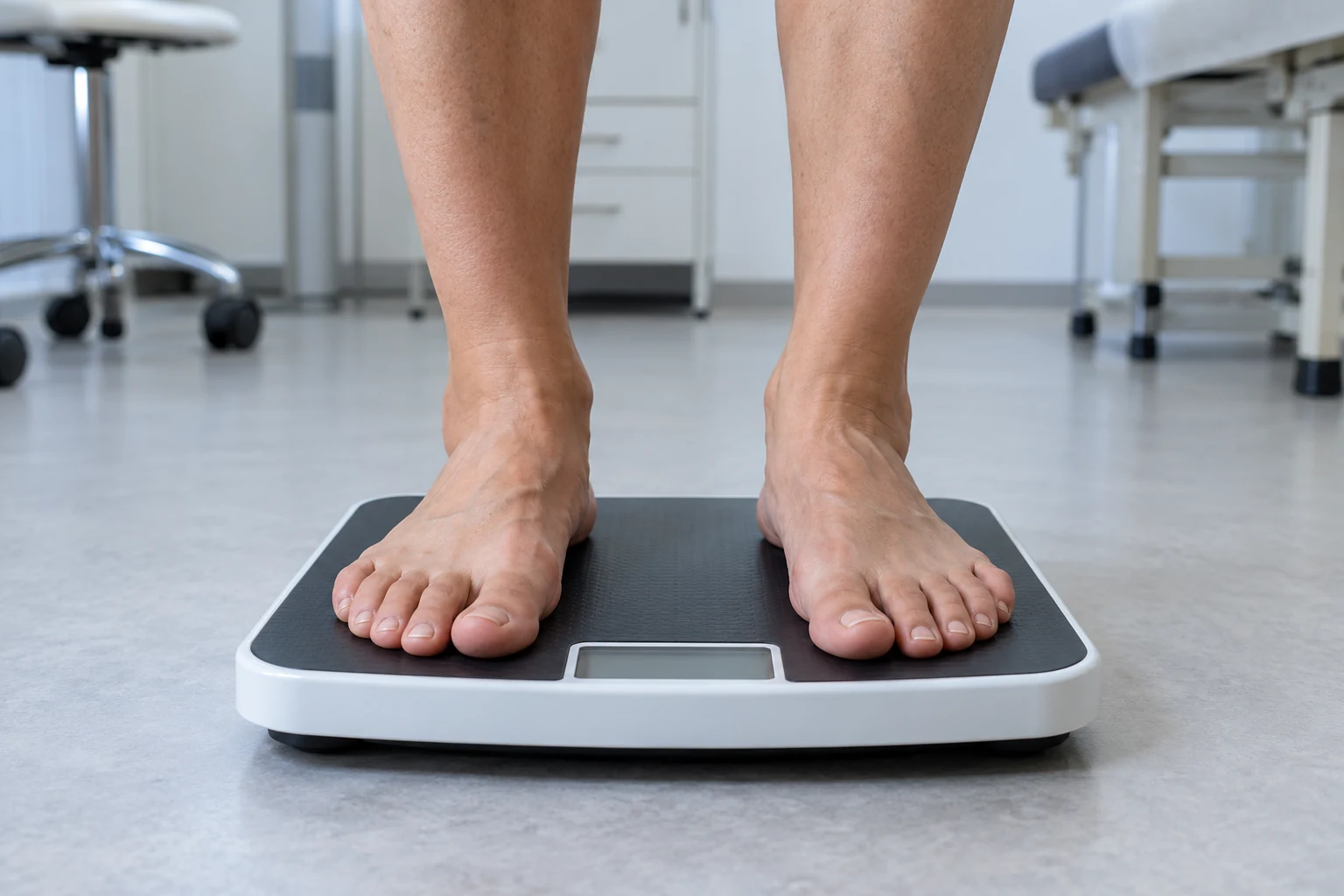
Record weight
Measure weight using a calibrated scale and record it in kilograms.
Keep the equation explicit
Use the selected Nadler equation and keep the inputs and result documented.
Calculation & Assumptions
Male: BV = 0.3669h³ + 0.03219w + 0.6041.
Female: BV = 0.3561h³ + 0.03308w + 0.1833.
Where: h = height in metres, w = weight in kilograms, BV = estimated blood volume in litres.
Input limits & precision
Positive height up to 300 cm and weight up to 1,000 kg are accepted, with up to six decimal places. These are software limits, not clinical reference ranges. This is an adult estimation equation; it is not a direct blood-volume measurement or a separate model for children or pregnancy. Decimal arithmetic is retained without intermediate rounding. Litres are displayed to two decimals; millilitres are rounded separately to the nearest whole mL from the unrounded estimate. Copy and TXT include the unrounded arithmetic estimate.
Frequently asked questions
Is this a measurement or an estimate?
This is an estimate from the adult Nadler equation, not a direct measurement of current circulating blood volume. Body composition and clinical conditions can affect accuracy.
Which equation profile should I use?
The selector chooses the published male or female Nadler coefficients. Use the equation profile required by your clinical or research context. It does not infer a profile from your measurements.
Does this calculate plasma volume?
No. It estimates total blood volume only. It does not measure plasma or red-cell proportions and does not calculate a blood-donation allowance.
More questions (5)
Which values should I enter?
Choose the male or female Nadler equation profile, then enter adult height in centimetres and weight in kilograms. Height is converted to metres internally.
What formula does this calculator use?
The adult Nadler equations estimate blood volume in litres. Male: 0.3669h³ + 0.03219w + 0.6041. Female: 0.3561h³ + 0.03308w + 0.1833. Here h is height in metres and w is weight in kilograms.
What does the Blood Volume calculate?
Blood Volume Calculator Estimate your total blood volume with the Nadler formula. Enter your sex, height, and weight, and this calculator returns your approximate blood volume in litres and millilitres, plus the amount per kilogram of body weight. — free online calculator.
Why might my result differ from another source?
Results can differ because measurement methods, rounding and assumptions vary. This calculator is an estimate and is not a medical diagnosis.
Does the result update automatically?
Yes. Changing an input updates the result using the same calculation engine shown on this page.
Sources & References
BookshelfPhysiology, Blood VolumeBlood volume and its physiological contextNadler
et al.Prediction of blood volume in normal human adultsOriginal study · Surgery (1962)
References provide context, not endorsement.