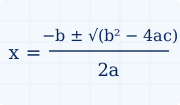
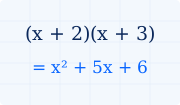
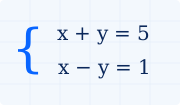
Complete the square. See the turning point.
 Standard formEnter a, b and c
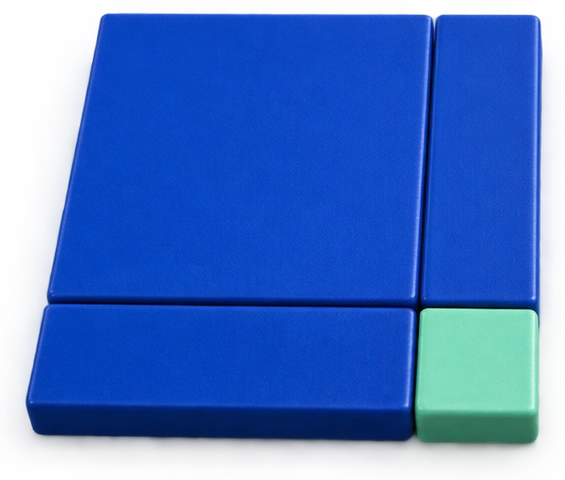 Complete the squareBuild the perfect square
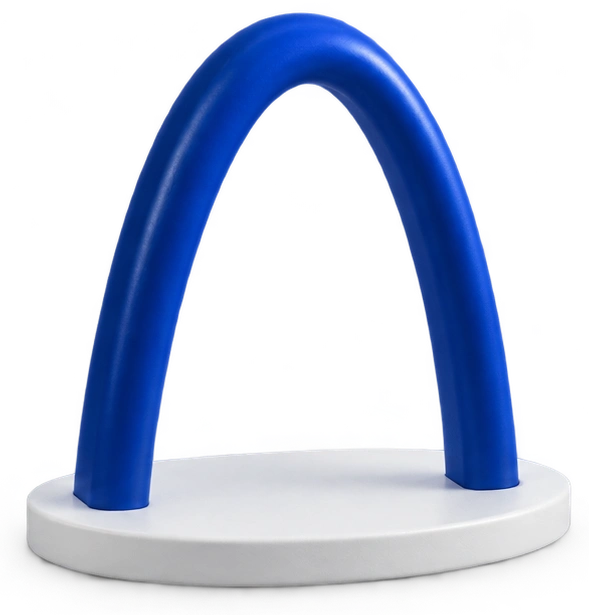 Vertex & rootsExplore your parabola
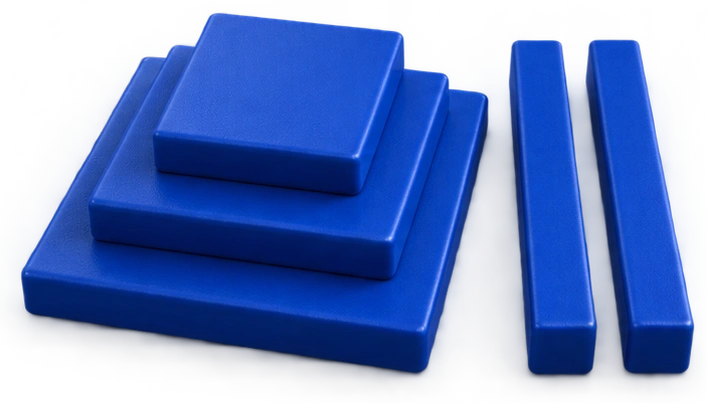
Where does the extra 9 come from?
Illustrative algebra tiles · not to scale


Vertex form
Step-by-step solution
Your parabola
Text summary · PDF in member tools
Why completing the square works
For any real number p,
Adding and subtracting the same quantity preserves the expression. First divide the equation by a, then use p = b/(2a). The square you add is p².
Frequently asked questions
Why must a be nonzero?
A nonzero coefficient of x² makes the expression quadratic. With a = 0 the equation is linear or constant, so this quadratic vertex method does not apply.
What if there are no real roots?
The completed square and vertex still exist. When −k/a is negative, the roots are the complex conjugates h ± i√(k/a). The real parabola does not cross the x-axis.
Can I enter fractions?
Yes. Enter numbers, decimals with up to six places or fractions such as -3/2. The calculator keeps exact rational values for the completed square. Each nonzero coefficient must have magnitude from 0.000001 to 1,000,000, and fraction denominators may be at most 1,000,000.
What does the vertex tell me?
The vertex (h,k) is the turning point of the parabola. It is a minimum when a is positive and a maximum when a is negative. The line x = h is the axis of symmetry.
Show all questions (13)Show fewer questions
How does the area diagram work?
For a positive half-coefficient p=b/(2a), an x² square and two px strips leave a p² corner. Filling it makes (x+p)². Negative p represents subtraction, so the diagram switches to a signed algebra explanation rather than drawing negative lengths. The diagram is schematic and not to scale.
Why can a radical remain in the answer?
A non-perfect rational square has an irrational square root. The exact result keeps that radical and also shows a decimal approximation. Radical fractions are exact and may not be reduced to the shortest possible radical form.
Is 1.4375 wrong for a=4, b=3, c=2?
No. It equals k=23/16, the y-coordinate of the vertex. It is only part of the answer: the full form is 4(x+3/8)²+23/16, with vertex (−3/8,23/16) and no real roots.
Does the graph show exact values?
The labels preserve exact rational or radical results; the SVG curve uses floating-point coordinates for display. The default view fits the vertex and real roots. A faraway y-intercept can be outside the view; use Include y-intercept to fit it too. No-real-root cases show no x-intercept markers.
What does the Completing the Square calculate?
Complete the square. See the turning point.
Which values should I enter?
Enter a, b, c in that order. a must be nonzero. Numbers, decimals or fractions are accepted.
What formula does this calculator use?
h=−b/(2a), k=c−b²/(4a), and ax²+bx+c=a(x−h)²+k. Roots are found by solving (x−h)²=−k/a.
Why might my result differ from another source?
Check coefficient signs, fractions and rounding. Equivalent completed-square forms can look different. Complex roots do not correspond to real x-intercepts.
Does the result update automatically?
Yes. Editing a coefficient updates results, the diagram, graph and expandable solution. Invalid input clears old results.