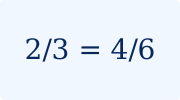
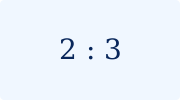
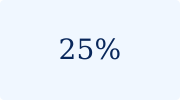
Find the missing value. See why the ratios match.
 Set the proportionEnter any three values.
 Follow the cross productsSee the diagonal pairs.
 Check the equalityCompare exact results.
Follow the diagonal pairs


Solved value
Step-by-step solution
Check your answer
Text summary · PDF in member tools
Why cross multiplication works
Multiplying both sides by b × d removes the denominators. Both denominators must be nonzero.
Zero is a value, not a request to solve. Leave the unknown blank.
Frequently asked questions
Can any term be the unknown?
Yes. Leave exactly one field blank. Fill all four to check the proportion. Zero is a real value, not a missing-value marker.
Can I use decimals or fractions?
Decimals work in normal numeric fields. Enable Fraction inputs to enter exact fractions or a question mark for the unknown. Exact rational arithmetic keeps equality checks separate from approximate decimals.
What happens if a denominator is zero?
The denominators b and d must be nonzero. Cross-product equality alone does not make a fraction with denominator zero valid.
How do I check a completed proportion?
Fill all four fields. The calculator compares ad and bc exactly and shows whether the two defined ratios agree.
Show all questions (12)Show fewer questions
Can there be no solution or many solutions?
Yes. If the coefficient multiplying the unknown is zero, the product equation may be inconsistent or may allow many values. An unknown denominator must still be nonzero.
What limits apply?
Numbers and decimal input up to six places are supported. Nonzero magnitudes range from 0.000001 to 1000000; fraction denominators may be at most 1000000. Exact results can be larger.
Why does the decimal have an approximation sign?
Ratios such as 2/3 repeat forever in decimal form. Their displayed decimal is rounded; the fraction and equality check remain exact.
What does the Cross Multiplication calculate?
It solves any one missing term of a proportion or checks the equality of four entered values.
Which values should I enter?
Enter any three values and leave the unknown blank. Fill all four to check. Zero is a value, not a missing marker.
What formula does this calculator use?
a/b=c/d is equivalent to ad=bc when b and d are nonzero.
Why might my result differ from another source?
Results can differ when another source uses different units, rounding rules, conventions or assumptions. Compare the inputs and definitions before comparing results.
Does the result update automatically?
Yes. Changing an input updates the result using the same calculation engine shown on this page.