Cycling Distance & Time Calculator
Ride Planning & Climbing Studio
Plan distance, time and pace. Explore the effort behind your ride.
Ride dashboard
Model comparison,
not actual route length.
MET 10.0 · estimates depend on effort and assumptions
Road cycling speed-band estimate from the 2024 Adult Compendium.
Estimated active energy: ≈ 675 kcal (resting energy excluded).
MET energy and mechanical power are independent estimates. Speed bands are approximate selections of published activity categories. Adult Compendium values concern ages 19–59; individual energy expenditure varies with fitness, conditions and physiology.
Understand your climb


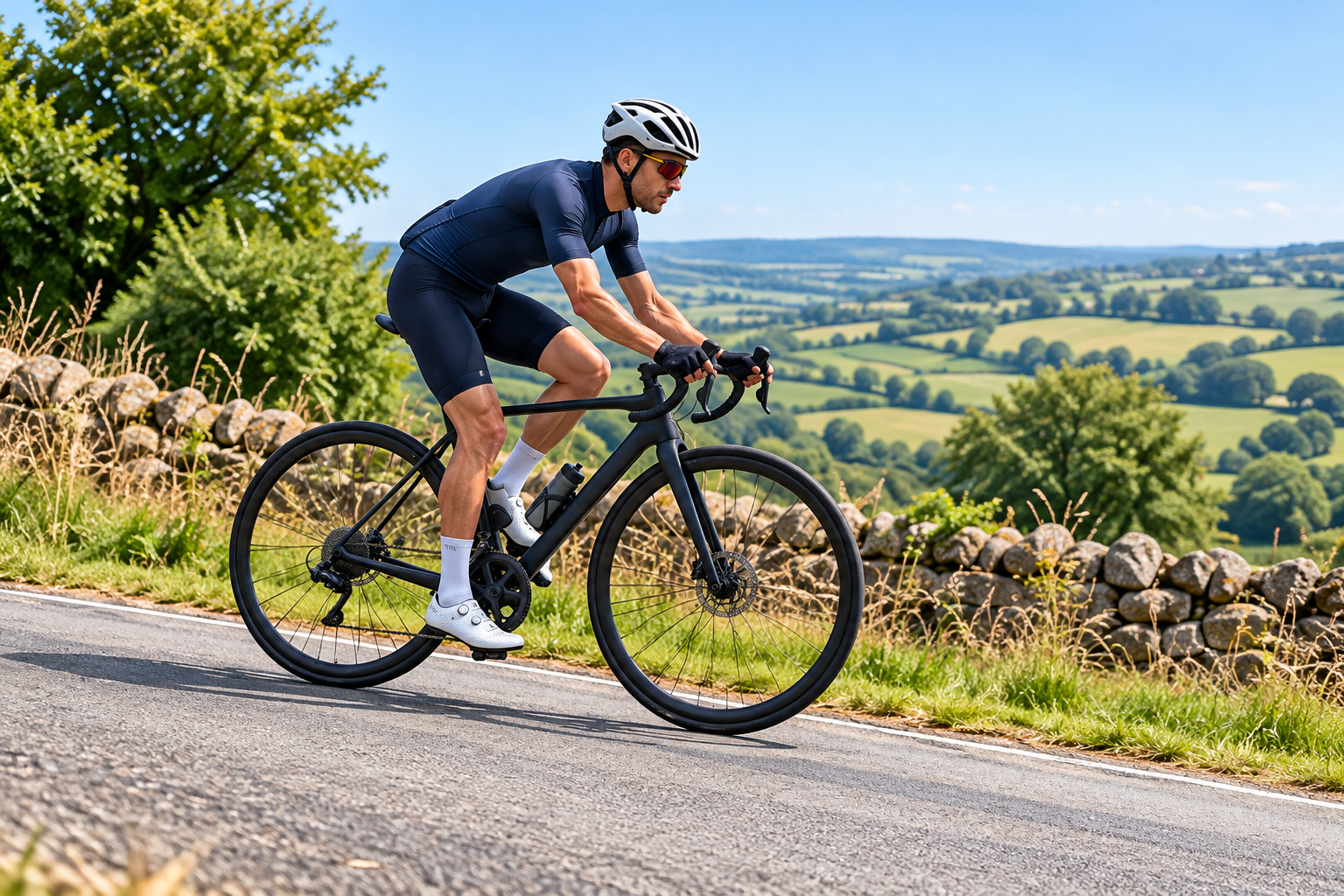
Total ascent measures effort; it cannot reconstruct the route profile.
Distance = speed × timeMultiply moving-average speed by moving time.
Climbing needs extra mechanical workGaining elevation increases the energy required.
Calories and power are different estimatesThey are related but not the same measurement.
Formula & worked example
25 km/h × 1 h = 25 km
10.0 MET × 75 kg × 1 h ≈ 750 kcal
Climbing work = total mass × g × ascent
85 × 9.80665 × 100 ≈ 83.4 kJ
Gross calories include resting energy; individual expenditure varies.
Power & equivalent-distance equations
v is speed in m/s; D is traveled distance in metres; H is total ascent; m is rider + bike + carried mass; t is moving time in seconds; η is drivetrain efficiency.
F₀ = Crr × m × g + ½ρ × CdA × v²
Work at crank ≈ (F₀ × D + m × g × H) ÷ η
Modeled power ≈ work at crank ÷ t
Equivalent flat distance = D + m × g × H ÷ F₀
At the default assumptions: Crr = 0.005, CdA = 0.32 m², air density = 1.225 kg/m³, efficiency = 97%, bike = 10 kg; modeled power ≈ 121 W and flat-road work equivalent ≈ 31.1 km. This is a simplified no-wind work budget, not a reproduction of a measured route or of the full Martin model. It does not alter the 25 km actual distance or add climbing calories to the MET estimate.
Frequently asked questions
Moving time or elapsed time?
Use moving time with moving-average speed. Elapsed time includes stops; mixing it with moving-average speed overestimates distance. The tool does not add rest stops.
Does climbing change the distance?
No. Distance remains speed × time. There is no universal 0.5% correction per 100 m of ascent. The separate flat-road energy equivalent compares modeled mechanical work at the same speed under your assumptions; it is not extra distance traveled.
How is cycling power estimated?
The simplified steady-speed work budget adds air resistance, approximate flat-road rolling resistance and positive climbing work, then divides by drivetrain efficiency and moving time. It omits wind, drafting, accelerations, braking and descents. It is not a power-meter reading.
Is the energy estimate personalized?
It uses your weight, moving time and a selected MET activity category. Road mode chooses an approximate speed band; mountain and commuter modes use their stated activity categories. A custom MET can be entered. Real energy use can differ substantially. This is an educational estimate, not a nutrition or clinical prescription.
Why is the ascent preview not a route profile?
A single ascent total does not reveal where climbs, descents or flat sections occur. The hillside is illustrative. Ascent per kilometre is cumulative climbing density, not a measured road gradient.
Sources & references
CompendiumCycling MET valuesAdult Compendium of Physical Activities.Martin et al.Cycling power model · 1998Background on cycling resistance and power.
Independent educational tool. No affiliation or endorsement. Sources checked 19 October 2026.
Calculate cycling distance, moving time or average speed; explore ascent, MET energy and modeled power.