

Doppler Echo Cardiac Output Calculator
From Doppler measurements to blood flow. Follow each calculation step.
Your Measurements
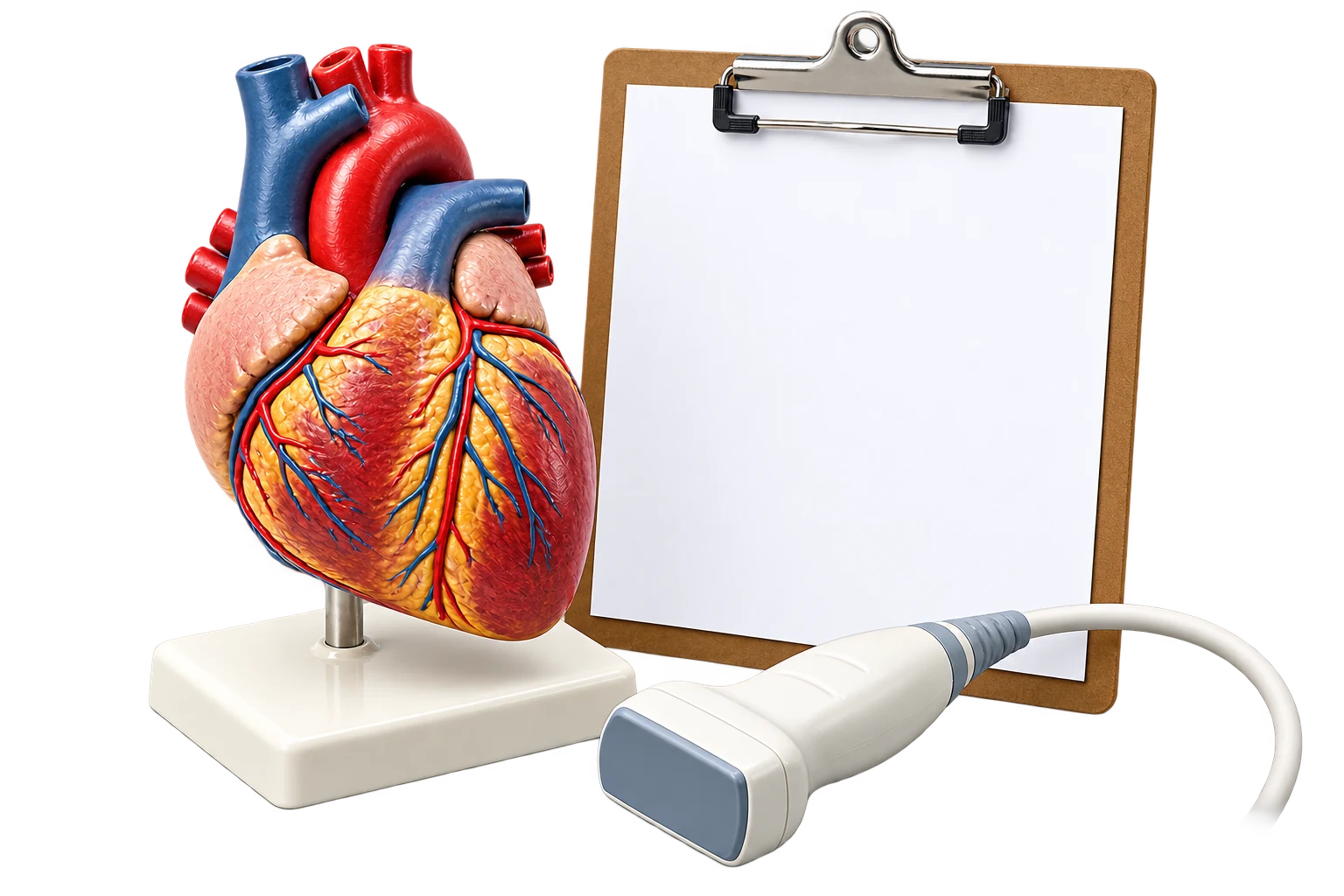
Illustrative equipment — enter your measured values.
What the Inputs Mean
Diameter (d)
Width of the LVOT (cm) used to calculate area.
LVOT VTI
Distance travelled by blood through the LVOT per beat (cm).
Heart rate
Beats per minute (bpm) during the measurement.

Use the Right Inputs
- Use centimetres for both diameter and VTI.
- Use compatible LVOT measurements from the same assessment.
- The LVOT diameter is squared to compute area.
Your Estimated Cardiac Output
Calculated estimate · rounded to 2 decimals.
Follow the Calculation
Diameter → Area
CSA = π × (d / 2)²
Area × VTI → Stroke volume
SV = CSA × VTI
Stroke volume × Heart rate → Output
CO = SV × HR / 1,000
Intermediate values shown rounded; full precision is used.
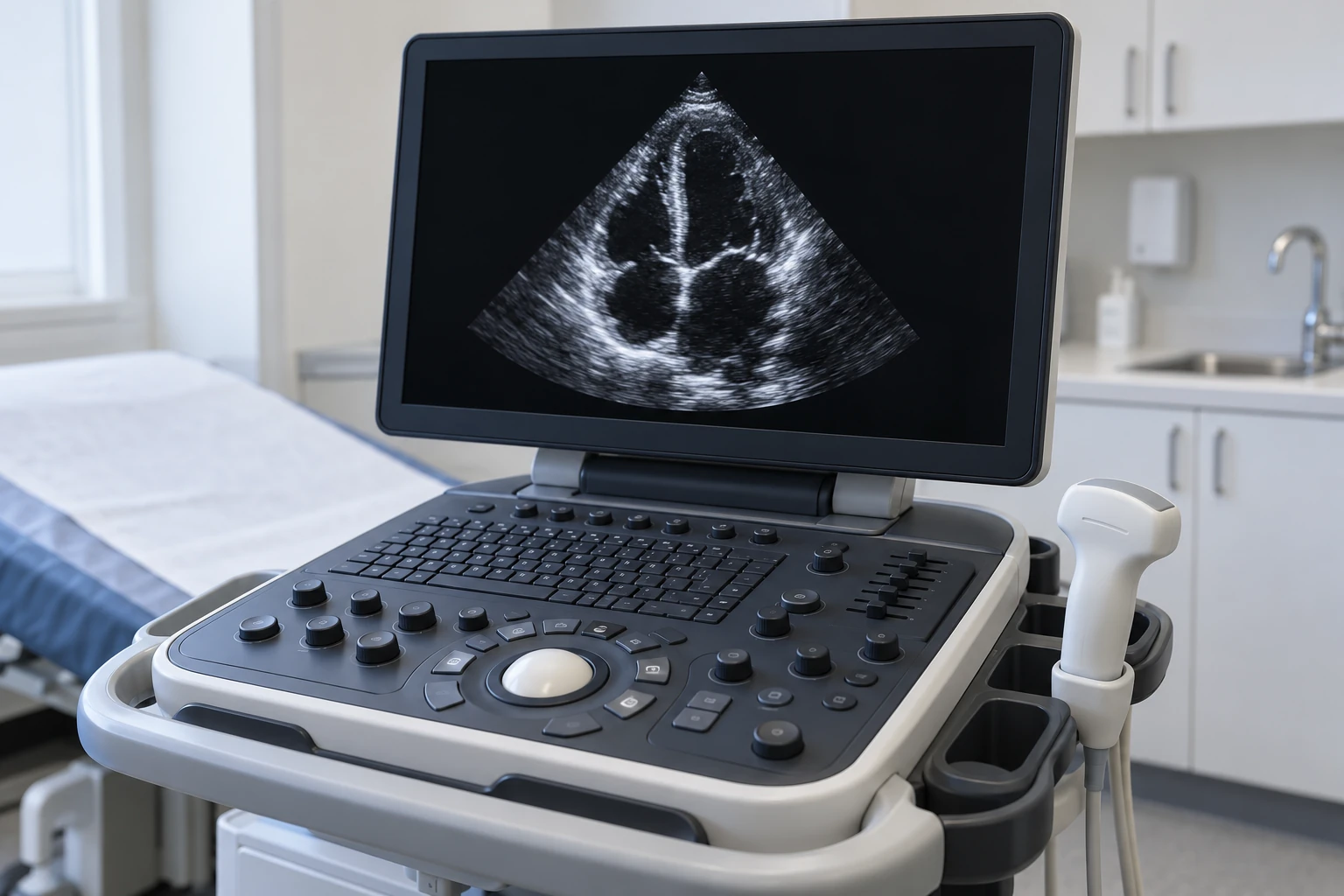
Echocardiography workstation.
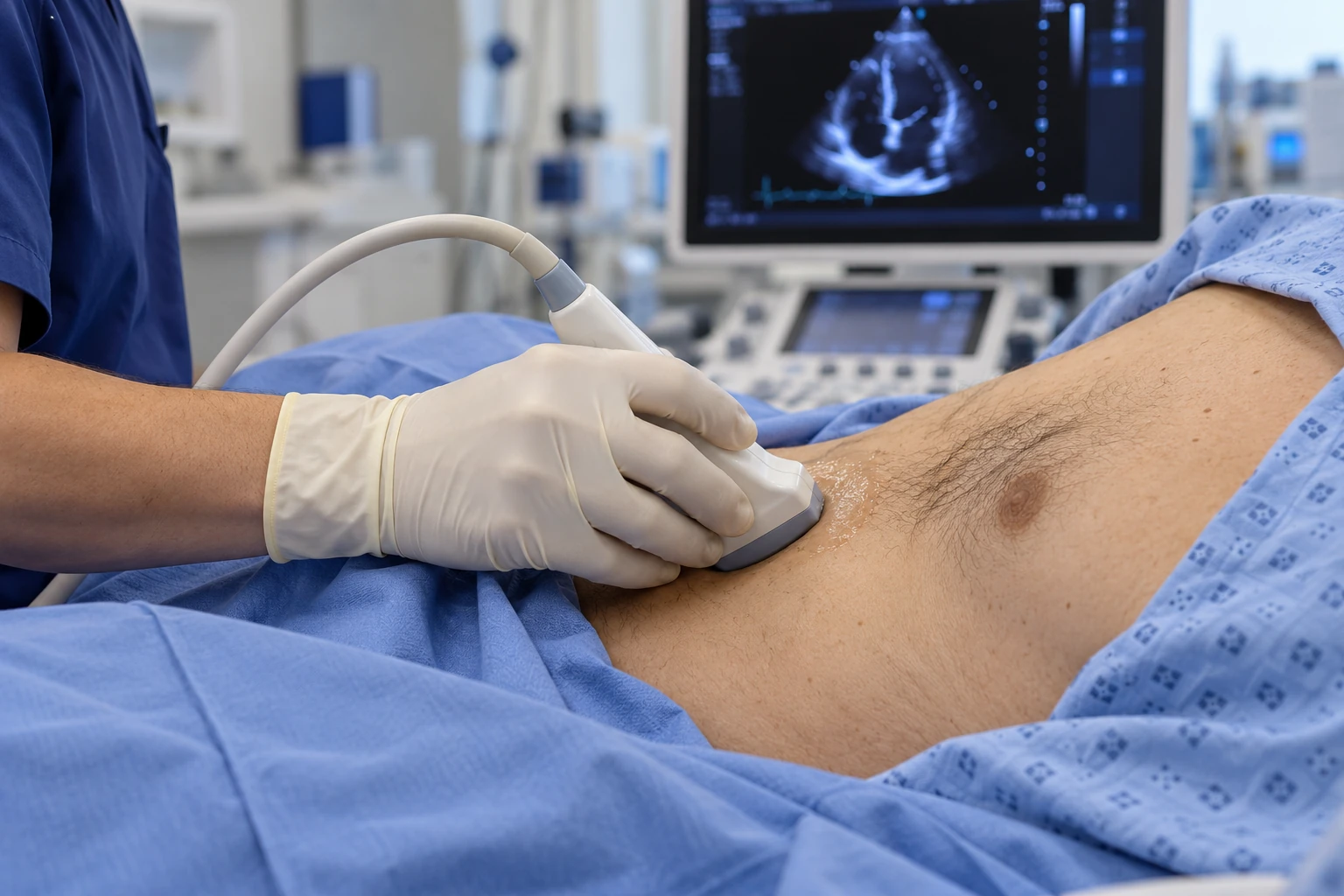
Probe in use during echocardiography.
Measurements are supplied by the user.
A Closer Look at the Measurements
Measure LVOT diameter
Use the diameter documented in the assessment.
Obtain LVOT VTI
Use a compatible LVOT VTI measurement in cm.

Match the heart rate
Use the heart rate from the same assessment.
Calculation & Assumptions
Formulas: CSA = π(d / 2)²; SV = CSA × VTI; CO = SV × HR / 1,000.
Units: d and VTI in cm; CSA in cm²; SV in mL; CO in L/min. 1 cm³ = 1 mL.
Assumptions: Circular LVOT, compatible measurements from the same assessment, no intermediate rounding.
Input limits & precision
All inputs must be greater than zero, with at most six decimal places. Software upper limits: diameter 20 cm, VTI 1,000 cm and heart rate 500 bpm. These are not clinical reference ranges. Decimal coefficients of π are calculated with scaled integers. A 50-decimal approximation of π is used without intermediate rounding; displayed results are rounded to two decimals. Tiny positive outputs are shown as < 0.005 in the relevant unit, instead of zero. The worked steps and exports retain the full decimal coefficients of π.
Frequently asked questions
What is LVOT VTI?
The LVOT velocity–time integral represents the distance blood travels through the left ventricular outflow tract during one beat. Enter the measured value in centimetres. It is not a velocity in cm/s.
Why does diameter matter?
The circular cross-sectional area is π × (diameter / 2)². Because diameter is squared, a measurement error affects the calculated area, stroke volume and cardiac output.
Does this directly measure cardiac output?
This page estimates output from values you supply. It assumes a circular LVOT and compatible area and VTI measurements. Measurement quality and clinical conditions can affect the result; this arithmetic cannot diagnose a condition.
More questions (5)
What does the Doppler Echo Cardiac Output calculate?
Doppler Echo Cardiac Output Calculator The Doppler Echo Cardiac Output Calculator estimates stroke volume and cardiac output from the LVOT diameter, LVOT velocity-time integral (VTI), and heart rate. For clinical education only. — free online calculator.
Which values should I enter?
Enter LVOT Diameter, LVOT VTI, Heart Rate using the units and format shown beside each field.
What formula does this calculator use?
The calculator uses the following relationship: CSA = π(LVOT/2)²; SV = CSA × VTI; CO = SV × HR ÷ 1000.
Why might my result differ from another source?
Results can differ because measurement methods, rounding and assumptions vary. This calculator is an estimate and is not a medical diagnosis.
Does the result update automatically?
Yes. Changing an input updates the result using the same calculation engine shown on this page.
Sources & References
BookshelfEchocardiography hemodynamicsStatPearls · Clinical backgroundThe Ultrasound
JournalDoppler cardiac outputVTI, stroke volume and measurement assumptions
References provide context, not endorsement.