

ECG Heart Rate Calculator
From the R–R interval to beats per minute. Follow the time conversion.
Your Measurement
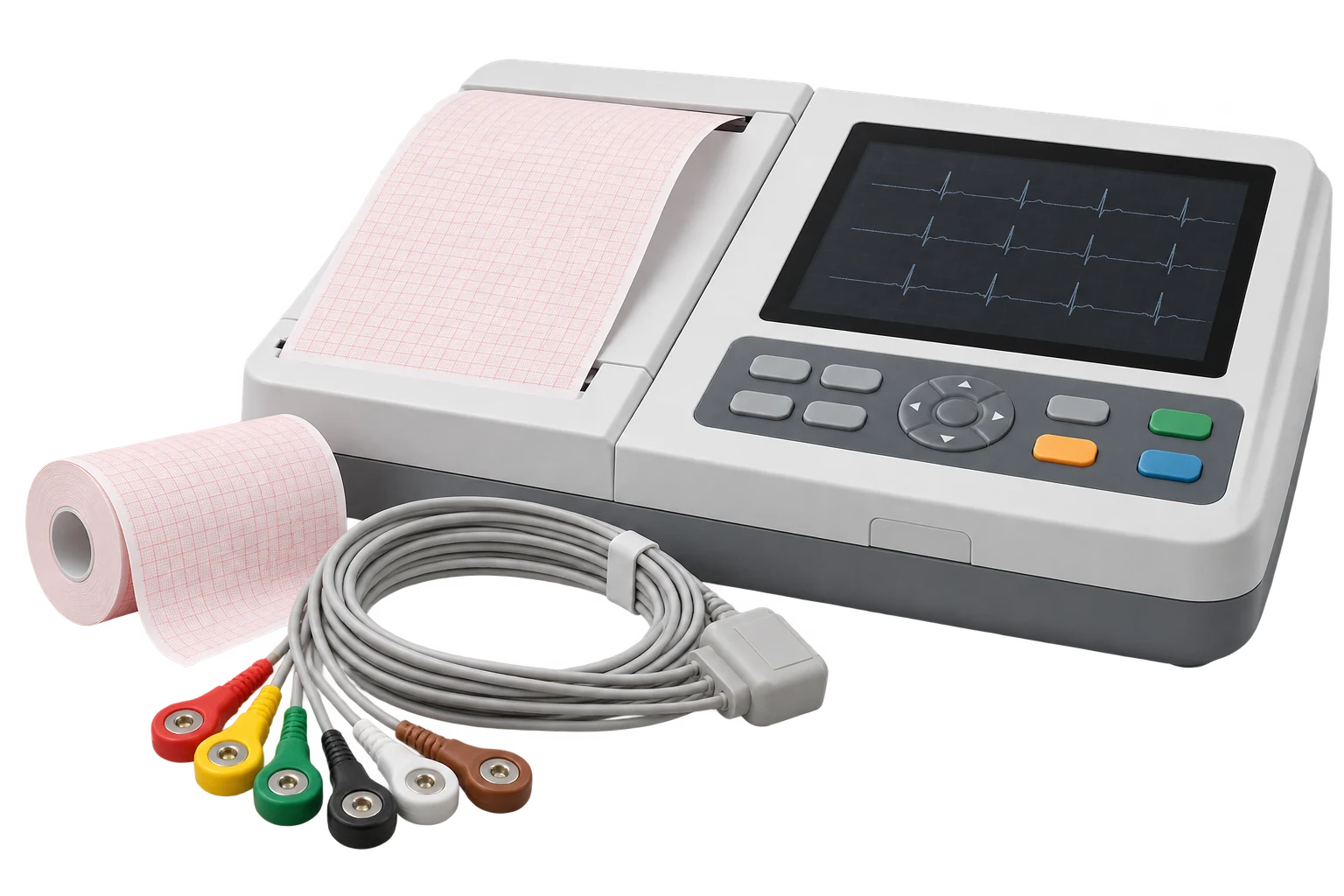
Illustrative equipment — enter your measured interval.
What the Interval Means
R–R interval
Time between consecutive R peaks.
Milliseconds
1,000 ms = 1 second.
Schematic only — not a patient ECG; spacing is illustrative.
Use the Right Input
- Enter an interval in milliseconds.
- A single interval gives an interval-based rate.
- Irregular rhythms need a broader rhythm assessment.
Your Calculated Heart Rate
Interval-based rate · rounded to 2 decimals.
From Interval to Heart Rate
Start with the measured interval
Convert to seconds
Calculate beats per minute
How Is This Calculated?
HR = 60,000 / RR (ms)
ECG recorder used in clinical practice.

Clinician reviewing ECG paper.
Photos are illustrative; the interval is supplied by the user.
A Closer Look at the Measurement
Identify consecutive R peaks
Find two consecutive R peaks on the ECG recording.
Measure the interval
Measure the time between the two R peaks in milliseconds.

Review the rhythm
Assess the rhythm in the broader clinical context, especially if irregular.
Calculation & Assumptions
Formulas: 60,000 ms per minute. HR = 60,000 / RR (ms).
Assumptions: The interval is supplied correctly from the ECG recording. The result is not an average rate from an irregular recording.
Input limits & precision
The interval must be greater than 0 and at most 600,000 ms, with up to six decimal places. This is a software limit, not a clinical reference range. The seconds conversion is exact for accepted inputs. The heart-rate calculation retains an exact reduced fraction; the displayed rate is rounded to two decimals. Worked equations use ≈ when the displayed rate is rounded. Copy and TXT retain the exact fraction.
Frequently asked questions
What is an R–R interval?
It is the time between two consecutive R peaks on an ECG. Enter that interval in milliseconds. The resulting rate describes that interval.
Does this diagnose an arrhythmia?
No. One interval does not establish rhythm regularity or diagnose an arrhythmia. ECG interpretation requires the broader tracing and clinical context.
Is one interval the same as an average rate?
Not necessarily. When intervals vary, the rate from one interval is not the average rate of the recording. This page does not average a series of intervals.
More questions (5)
Which values should I enter?
Enter the R–R interval in milliseconds. No separate rate input is required: the calculator computes heart rate as 60,000 divided by that interval.
What does the ECG Heart Rate calculate?
ECG Heart Rate Calculator — free online calculator.
What formula does this calculator use?
The calculator uses the following relationship: HR = 60,000 ÷ (R-R interval in ms).
Why might my result differ from another source?
Results can differ because measurement methods, rounding and assumptions vary. This calculator is an estimate and is not a medical diagnosis.
Does the result update automatically?
Yes. Changing an input updates the result using the same calculation engine shown on this page.
Sources & References
BookshelfElectrocardiogramGeneral information about the electrocardiogramPsychophysiologyHeart rate and heart periodBackground on heart rate and periodicity
References provide context, not endorsement.