

GDU Calculator
Track heat accumulation. Plan your crop’s next milestone.
Temperature & Season Inputs
Heat Accumulation & Outlook
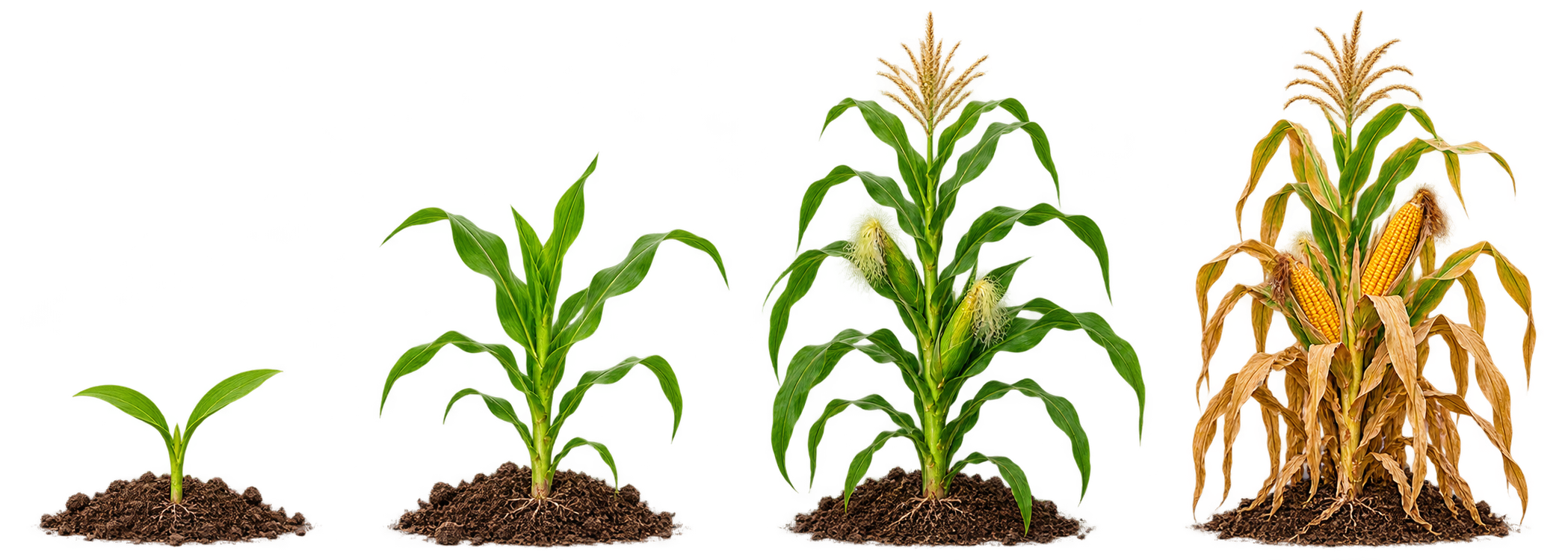
Corn Development Reference


If daily heat accumulation stays at 17.5 °F·days.
Next reference: silking in ≈42 days.Physiological maturity is not harvest-ready grain moisture.Season Heat Accumulation
Constant-temperature scenarioThe solid line uses your entered temperatures; the dashed line continues at the same daily rate. This is not an observed weather series.
Period values & projection details
| Day | Heat units in period | Total with previous heat | Basis |
|---|
Sampled values follow the exact same constant-rate calculation, not measured weather. The report contains all period days up to 366, otherwise evenly spaced samples and the endpoint.
How the calculation works
Daily heat units = (80 + 55) ÷ 2 − 50 = 17.5 °F·days
Total for 30 days = 17.5 × 30 = 525 °F·days
Using the modified corn method (minimum 50°F, maximum 86°F).
Units, assumptions & limitations
Temperature readings convert using °C = (°F − 32) × 5/9. Accumulated degree-days are temperature differences multiplied by time: °C·days = °F·days × 5/9. Never subtract 32 from an accumulated heat-unit total.
The modified method caps the daily high at the upper threshold, floors the daily low at the base and floors the resulting daily heat units at zero. The simple mean method uses the unmodified daily high and low, subtracts the base and floors negative results at zero. Methods are not interchangeable.
Repeated daily high and low values are a constant-temperature scenario. Real weather changes each day; averaging daily weather first and then applying caps can differ from summing capped daily values. No weather service, station data or seasonal forecast is connected.
Corn landmarks are illustrative thermal references, not observations or guaranteed dates. Hybrid, planting time, water, stress and local conditions matter. Soybean flowering also depends strongly on day length; wheat development may depend on vernalization and photoperiod. A generic heat budget does not predict these stages.
Date intervals count completed days from the period start to the period end. Previous heat units are added once. A maturity date is shown only when a period date is supplied and the target is reachable within 36,525 additional days at the entered rate. Grain drying and harvest conditions are separate.
Frequently asked questions
GDU or GDD — what’s the difference?
Growing degree units and growing degree days both describe accumulated thermal time. Always state the base temperature, cap method and Fahrenheit- or Celsius-degree-day scale before comparing totals.
Why do units change the total?
A Celsius degree is larger than a Fahrenheit degree. A total of 525 °F·days equals approximately 291.7 °C·days. The physical heat accumulation and the target progress remain the same.
Can this predict soybean flowering?
Not from heat units alone. Soybean flowering is strongly affected by day length and varietal adaptation. The soybean preset provides a configurable base-50°F heat budget, without copying corn stages or a corn maturity target.
Sources & References
 PioneerGrowing degree units, corn maturity ratings and hybrid differences.
 USDACrop progress terms and corn phenological stage definitions.
 Purdue UniversityExtension guidance on growing degree days and crop base temperatures.
Independent references, not endorsements. Additional methods: NOAA corn GDD; UMN soybean development.
Track heat accumulation. Plan your crop’s next milestone.