

Pulse Pressure Calculator
Understand the gap between your blood pressure numbers.
Your Blood Pressure
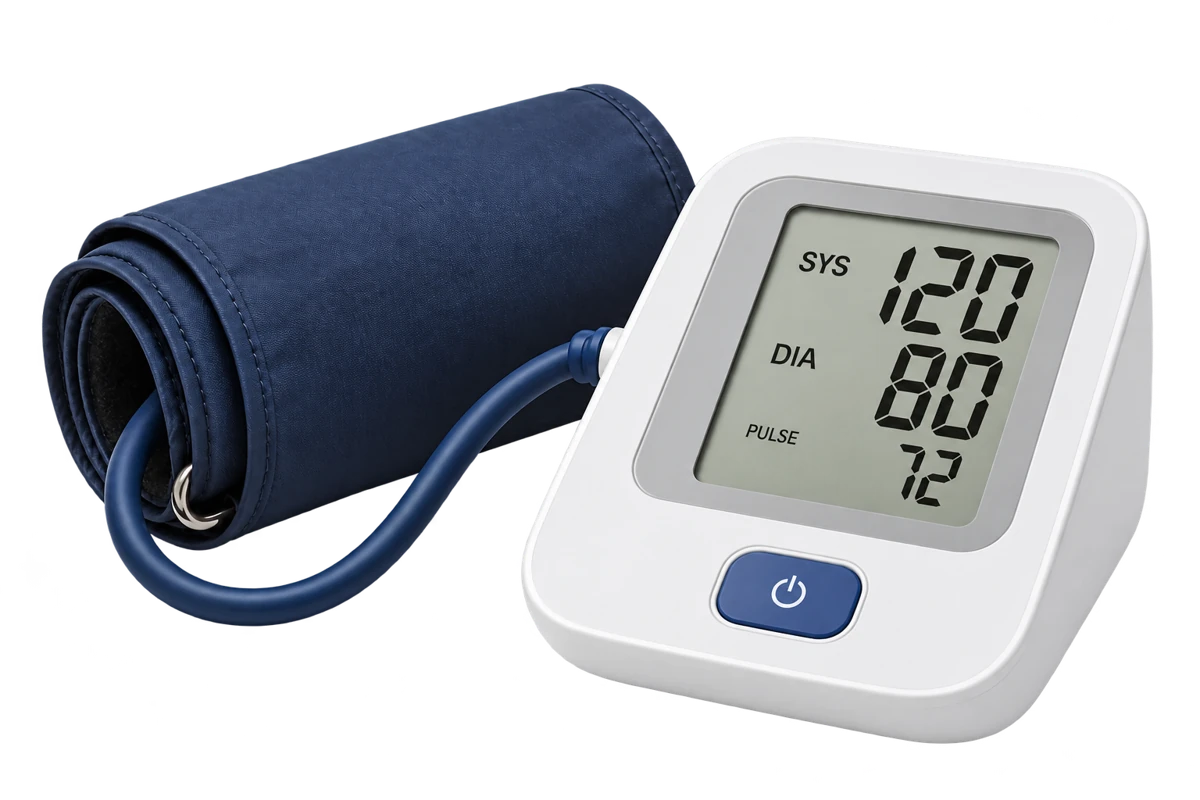
Device display is an illustrative example.
What the Numbers Mean
Systolic · Top number
Pressure when the heart contracts.
Diastolic · Bottom number
Pressure between heartbeats.

Before You Measure
- Rest quietly for 5 minutes.
- Support your arm at heart level.
- Use a correctly fitting upper-arm cuff.
Your Pulse Pressure
Difference between your two pressure values.
See the Pressure Difference
—Systolic
 —
Diastolic
Equipment photos are illustrative; captions reflect your inputs.
The Gap in Your Reading
Shared scale · pressure comparison, not an arterial waveform or risk scale.
How Is This Calculated?
PP = SBP − DBP
A Closer Look at Measuring Correctly

Sit comfortably
Keep your back supported and feet flat on the floor.

Support your arm
Rest your arm on a table at heart level.
Fit the cuff correctly
Use a properly sized upper-arm cuff that fits snugly.
Calculation & Assumptions
Formula: PP = SBP − DBP
Values: Use systolic and diastolic from the same reading.
Units: mmHg (millimetres of mercury).
Input limits & precision
Inputs support up to six decimal places, from 0 to 500 mmHg; systolic must be positive and at least diastolic. These are software limits, not clinical reference ranges. Equal values give a mathematical difference of zero. Decimal subtraction uses scaled integers.
Frequently asked questions
What is pulse pressure?
Pulse pressure is the difference between the systolic and diastolic values in the same blood pressure reading. It is measured in mmHg.
Is pulse pressure the same as heart rate?
No. Pulse pressure is a pressure difference in mmHg. Heart rate counts beats per minute.
Can this result diagnose a condition?
No. Interpretation depends on the full blood pressure reading and clinical context. Discuss concerns with a healthcare professional.
More questions (5)
What does the Pulse Pressure calculate?
Pulse Pressure Calculator — free online calculator.
Which values should I enter?
Enter Systolic, Diastolic using the units and format shown beside each field.
What formula does this calculator use?
The calculator uses the following relationship: Pulse pressure = Systolic − Diastolic.
Why might my result differ from another source?
Results can differ because measurement methods, rounding and assumptions vary. This calculator is an estimate and is not a medical diagnosis.
Does the result update automatically?
Yes. Changing an input updates the result using the same calculation engine shown on this page.
Sources & References
 Understanding blood pressure readingsAmerican Heart Association
 Pulse pressure explainedCleveland Clinic
References provide context, not endorsement.