

Volume Calculator
Explore the shape. Understand the formula. Measure the space.
VOLUME
m³
Exact form: 250π m³
Explore your cylinder
Drag to rotate
Schematic view. Dimensions drive the model.
Why the units are cubed
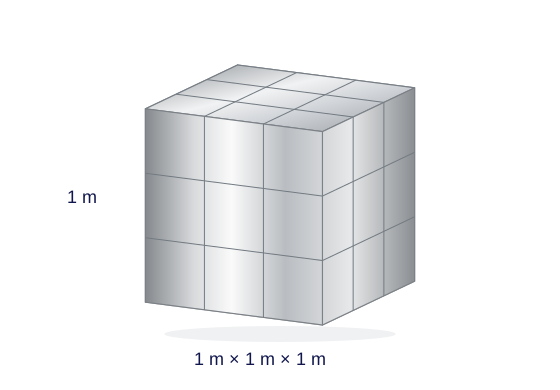
Lengths scale by k. Volume scales by k³.
Double every dimension → 8× the volume.
| 1 m³ | = | 1,000 L |
| 1 L | = | 1,000 cm³ |
Frequently asked questions
What is the difference between volume and surface area?
Volume measures the space inside a solid in cubic units. Surface area measures its outer covering in square units. This calculator includes every face of a closed solid.
Should I enter radius or diameter?
Enter the radius: half of the diameter. A diameter of 10 m means a radius of 5 m. Height is the perpendicular distance, not a slanted edge.
Do unit changes keep the same shape?
Yes. Changing cm, m, in or ft converts every stored dimension and keeps the physical object unchanged. Capacity in litres and US liquid gallons remains the same. Rounded displayed input values do not reduce the stored conversion precision.
Is the pyramid formula for a right pyramid?
The pyramid has a rectangular base and its apex directly above the base centre. Volume is base area × perpendicular height ÷ 3. Total surface area uses a separate slant height for each pair of faces.
Formula reference
| Shape | Volume | Surface area |
|---|---|---|
| Cube | a³ | 6a² |
| Rectangular prism | lwh | 2(lw + lh + wh) |
| Cylinder | πr²h | 2πr(r + h) |
| Sphere | 4πr³ / 3 | 4πr² |
| Cone | πr²h / 3 | πr(r + s) |
| Right rectangular pyramid | lwh / 3 | lw + l s₁ + w s₂ |
For a cone, s = √(r² + h²).
Pyramid: s₁ = √(h² + (w/2)²), s₂ = √(h² + (l/2)²).
Ideal closed solids; wall thickness excluded. Capacity assumes these are internal dimensions.
Sources & References
 OpenStaxGeometry fundamentalsVolume and surface-area formulas.
 SI BrochureThe International System of UnitsSI units and accepted volume units.
 NISTVolume and measurement units1 US liquid gallon = 231 in³ exactly.
References inform the content; no institutional endorsement.
Continue exploring Math
Explore the shape. Understand the formula. Measure the space.