Focus on the retina
A reference illustration of distance light focused on the retina.
Understand your acuity notation. Explore optotypes. Make sense of your prescription.
D is the distance assigned to the smallest chart line read, not the distance you held a screen or book.
Acuity describes central detail. It does not assess your entire visual field, eye health or ability to drive.
Standard reference acuity · not an eye-health diagnosis
Relative symbol sizes illustrate chart design. Screen size and viewing distance are not calibrated; this is not a home vision test.


| Snellen · feet | Snellen · metres | Decimal | logMAR |
|---|---|---|---|
| 20/20 | 6/6 | 1.00 | 0.000 |
| 20/40 | 6/12 | 0.50 | 0.301 |
| 20/100 | 6/30 | 0.20 | 0.699 |
| 20/200 | 6/60 | 0.10 | 1.000 |
6-metre and 20-foot notation express the same ratio; 6 m is not an exact physical conversion of 20 ft.
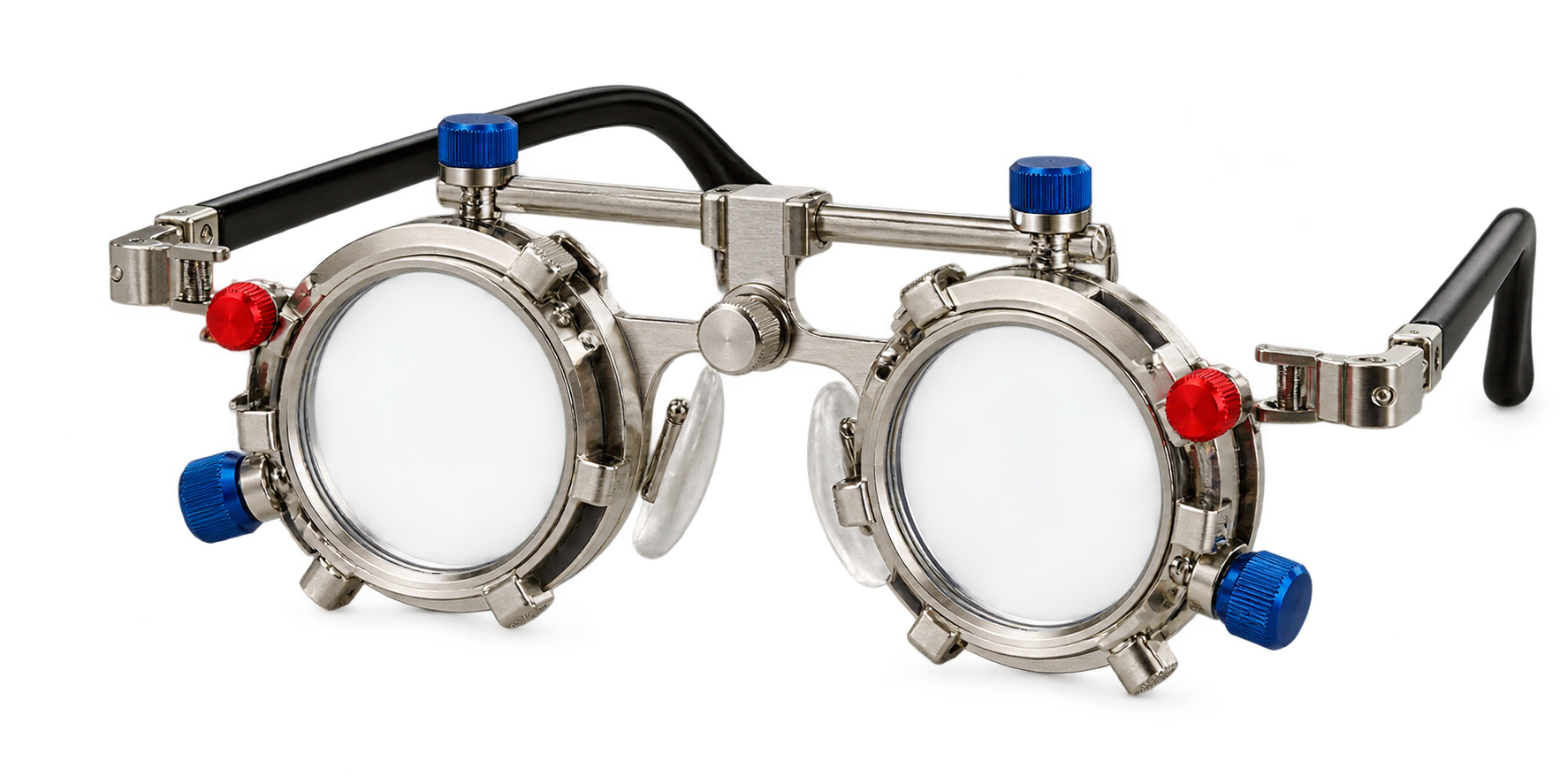 A prescription and an eye-chart result
SPH, CYL, axis and age cannot replace an acuity measurement.
Use the prescription tab to understand the notation.
Simplified distance-focus diagrams · illustrative, not to scale · accommodation relaxed
A reference illustration of distance light focused on the retina.
Distance light comes to a focus before reaching the retina.
Without accommodation, the optical focus falls behind the retina.
Move the slider to change the image effect. This has no conversion to Snellen acuity, lens power or an individual visual experience.

Standard central-detail acuity. A result alone does not establish that your eyes are healthy.
Licence requirements vary by jurisdiction and may include corrected vision, visual fields and other criteria.
Some US definitions use this threshold in the better eye with best correction. Visual-field criteria also apply.
Compute the acuity ratio:
20 / 40 = 0.50
Normalize the metric notation:
6 / 0.50 = 12 → 6/12
Convert to logMAR:
−log₁₀(0.50) ≈ 0.301
Decimal acuity is a notation ratio, not a percentage of total sight.
No. Sphere, cylinder and age do not determine a reliable Snellen acuity. Acuity must be measured; this page keeps the lens-power explanation separate from acuity conversions.
No. 20/20 is a reference for central detail at distance. It does not assess all aspects of vision, visual fields or eye health.
No. These optotypes are uncalibrated illustrations. Screen size, distance, lighting and testing procedure are not controlled.
No. Decimal acuity is a ratio used to write an acuity measurement. It is not a percentage of your total vision.
No. Some US definitions use 20/200 or worse in the better eye with best correction, or a restricted visual field. Eligibility depends on a professional assessment and local criteria.
logMAR is the base-10 logarithm of the minimum angle of resolution. A smaller angle means finer detail can be resolved, so lower logMAR denotes better measured acuity.
 Visual acuity & chart notationEyeWiki · clinical measurement context.
 Understanding low visionNIH · patient information.
 The Spherical EquivalentLens-power formula and limitations.
Independent educational references · No institutional endorsement or completed medical review claimed.
Further reading: NEI · Types of Refractive Errors · Presbyopia
Understand your acuity notation. Explore optotypes. Make sense of your prescription.