

Amniotic Fluid Index (AFI) Calculator
Add four ultrasound pocket depths to calculate AFI in centimetres.
Your ultrasound measurements
Before you calculate
AFI adds four depths; do not average them.
Use centimetres throughout. This page does not measure an ultrasound image.
Your amniotic fluid index
4 + 4 + 3 + 3
Four quadrants. One total.
How is this calculated?
Equipment guide
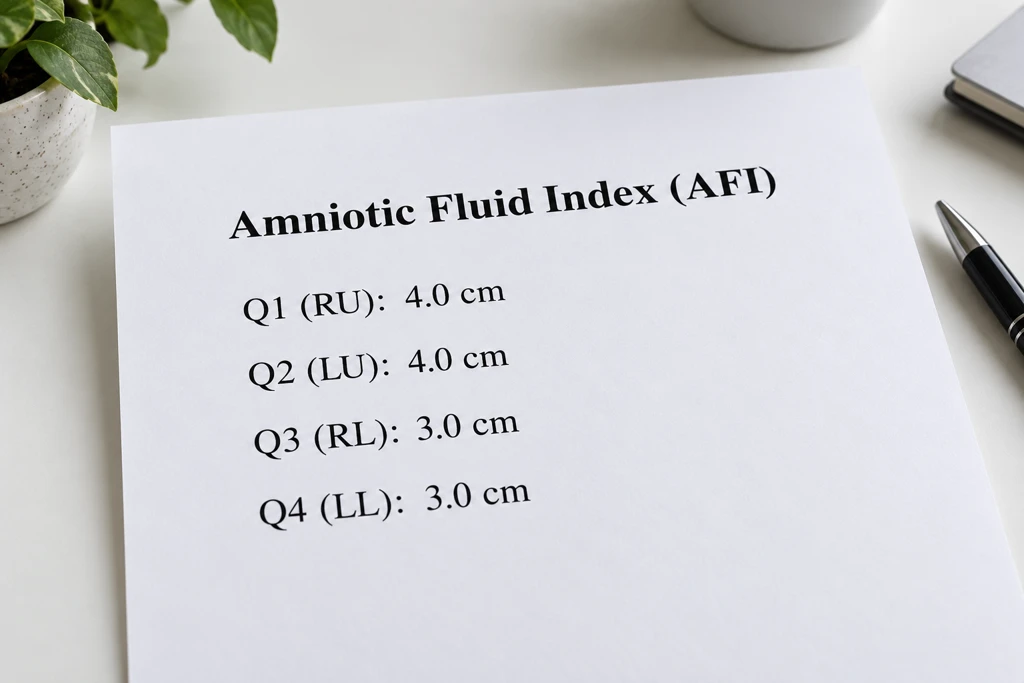
Read all four depths
Copy the four reported pocket measurements.
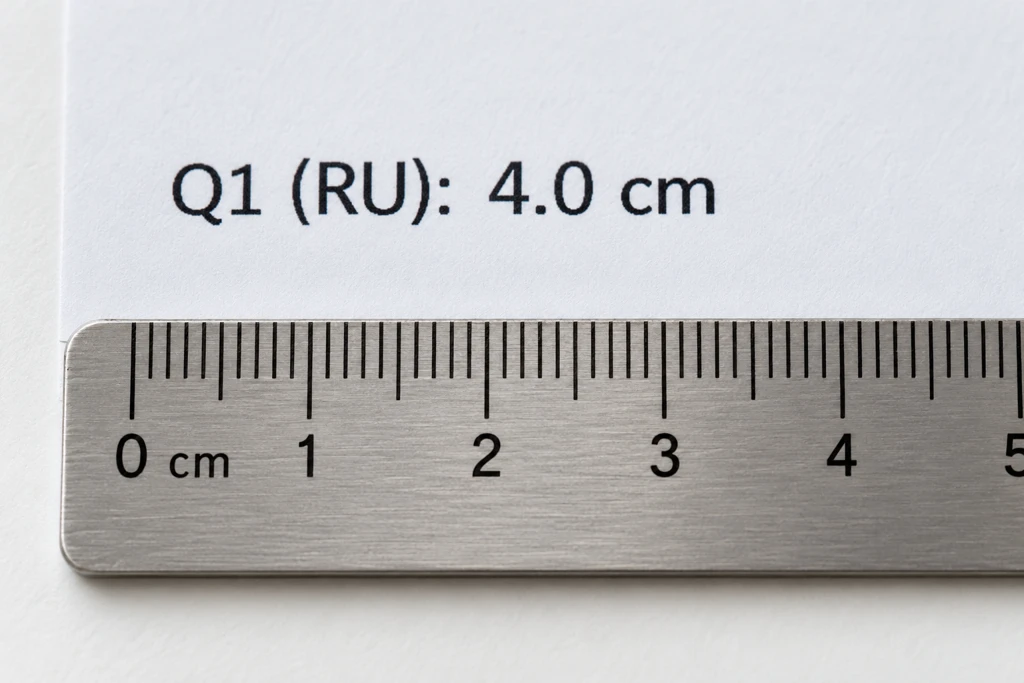
Check centimetres
Enter every depth in the same unit.
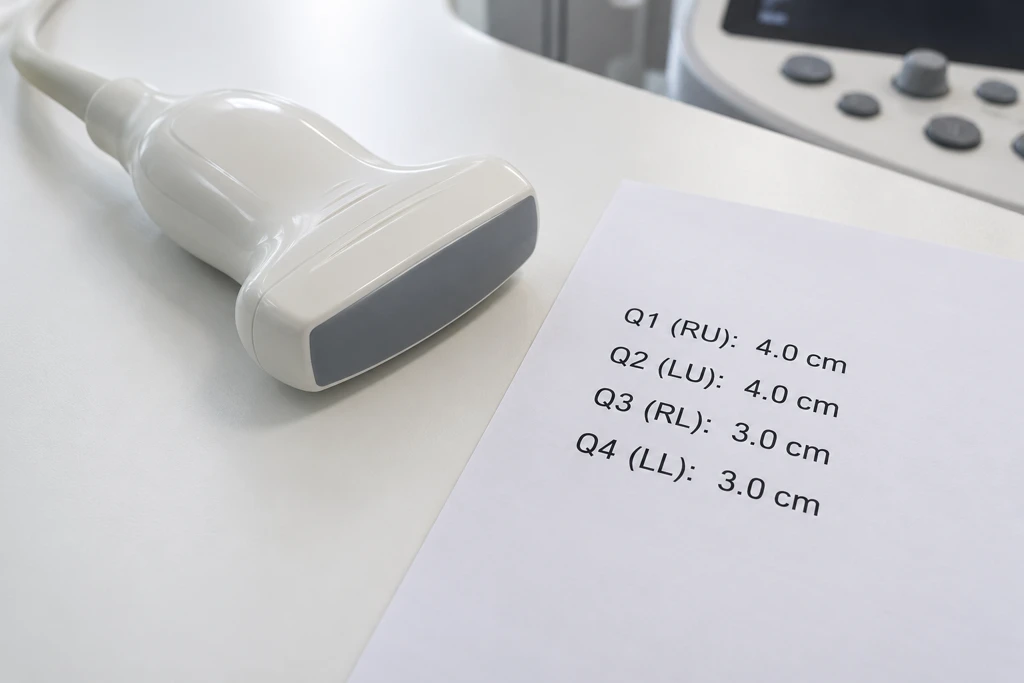
Keep the scan context
Use measurements from the same examination.
AFI and DVP are different measurements
AFI: four depths added together.
Use four quadrant measurements from a single scan examination.
DVP: one deepest vertical pocket.
A separate assessment using one suitable pocket.
Do not substitute a single pocket for the four-quadrant sum. AFI is a depth index, not a fluid volume in litres.
Calculation & assumptions
AFI = Q₁ + Q₂ + Q₃ + Q₄
Four non-negative clinician-measured depths in centimetres. This calculator adds the entered values; it does not assess fetal wellbeing.
Frequently asked questions
What does AFI calculate?
The amniotic fluid index is the sum of four ultrasound-measured vertical fluid pocket depths, one from each quadrant, expressed in centimetres. It is a depth index, not a directly measured fluid volume.
Which values should I enter?
Use the four non-negative pocket depths recorded by your ultrasound professional during the same examination, all in centimetres. Match each quadrant label to your report. Do not enter a single deepest pocket four times.
Why are the four measurements added?
The four-quadrant AFI method is defined by adding the four depths. The sum is not divided by four. For 4,4,3 and3cm, the AFI is14cm.
Is AFI the same as DVP?
No. AFI adds depths from four quadrants; deepest vertical pocket (DVP) assessment uses a single deepest suitable pocket. They are different measurements with different interpretation. This page only calculates AFI.
Does the result update automatically?
Yes. Editing any depth updates the AFI, individual contributions and worked calculation immediately. Invalid inputs clear these outputs and disable exports.
More questions (5)
What does the Amniotic Fluid Index (AFI) calculate?
It adds the four reported pocket depths in centimetres. It does not estimate fluid volume in litres, measure a scan image or assess fetal wellbeing.
What formula does this calculator use?
AFI = Q1 + Q2 + Q3 + Q4. The worked steps group the two upper and two lower entries before adding those subtotals. All calculations retain the original entered precision before display rounding.
Why might my result differ from another source?
Check that all four depths are from the same scan, use centimetres and match your report. Display rounding, measurement technique and use of AFI versus DVP can explain differences. A clinician must interpret the scan.
Are quadrant numbers universal?
Numbering can differ between reports. This page retains its original labels: Q1 right upper,Q2 left upper,Q3 right lower,Q4 left lower. Use the location labels to map your report. The tiles are contribution summaries,not an anatomical diagram.
What are the input limits and zero-value behavior?
Each depth must be0–30cm, with up to6decimal places and positive values at least0.000001cm. These are software limits,not clinical reference intervals. Zero is accepted for arithmetic. When all four values are zero, AFI is0cm and percentage shares are undefined; seek interpretation from your maternity team.
Sources & References
 ISUOG · Amniotic fluid assessmentPatient information and measurement context.
 Fetal Medicine FoundationFour-quadrant AFI definition.
References provide context, not endorsement.
Page information
Updated: October 27, 2026