

Sports Nutrition Timing Calculator
Fuel the session. Balance the day. Time your nutrition.
Your Daily Fueling Dashboard
Energy from macros · not a measured calorie requirement.
Macro Energy Split
Daily targets come first:
Timing supports your plan; it does not replace adequate daily intake.
Your Workout Fueling Timeline
18:00–19:30 · 90 minFlexible meal windows, not deadlines. Workout portions are included in daily totals.

Build Your Fueling Day
Pre-workout: comfort comes first
Choose familiar carbohydrate-rich foods and adjust portions to digestion and time available.
- Allow time for a larger meal
- Use a smaller snack closer to training
- Keep portions within your daily plan
Calculation & Assumptions
Energy = 4 × carbs + 4 × protein + 9 × fat
Example: (450 × 4) + (135 × 4) + (90 × 9) = 3,150 kcal
These estimates are not your personalized TDEE. They are planning values based on your inputs and transparent ST presets.
See the planning factors
Carbs: 6.0 g/kg · protein: 1.8 g/kg · fat: 1.2 g/kg.
Base carbohydrate factors: strength 6, endurance 7, HIIT 5.5, team sports 6 g/kg. Duration factors: ≤30 min 0.70; ≤60 min 0.85; ≤90 min 1.00; ≤120 min 1.10; ≤180 min 1.25; longer 1.50.
Performance: carbohydrate factor ×1, protein 1.8 g/kg, fat 1.2 g/kg. Fat-loss scenario: carbohydrate ×0.9, protein 2.0, fat 1.0. Muscle-gain scenario: carbohydrate ×1.1, protein 2.0, fat 1.2. These ST choices are illustrations, not official ISSN/ACSM equations or a guaranteed deficit/surplus.
Daily grams are rounded to whole grams before energy is calculated. Pre/post carbohydrate examples are each up to 1 g/kg and 30% of daily carbs; protein is each approximately ⅓ g/kg, capped at 25% of daily protein. During fuel is included in the daily carbohydrate budget.
Timing That Fits Your Training
Post-exercise meals can support recovery, but total daily protein and energy intake also matter. There is no mandatory 30-minute cutoff.
Intra-session carbohydrate may be useful for longer, demanding endurance sessions. It is not required for every workout.
Use flexible meal timing that fits your training, lifestyle and appetite. Rapid glycogen restoration is particularly relevant when the next session follows soon.
Frequently Asked Questions
How are the daily calories calculated?
Calories are calculated from the displayed macros: carbohydrate and protein contribute 4 kcal per gram, fat 9 kcal per gram. At 75 kg, the default strength/90-minute/performance preset gives 450 g carbohydrate, 135 g protein and 90 g fat, totaling 3,150 kcal. The presets are transparent ST examples, not a personalized TDEE or official calorie prescription.
Do I need protein within 30 minutes?
There is no universal 30-minute deadline. Total daily protein, its distribution across meals, your previous meal and training schedule matter. The post-workout window here is a flexible planning example, not a cutoff after which protein stops helping.
When are during-workout carbs useful?
ISSN discusses around 30–60 g carbohydrate per hour for prolonged, demanding endurance exercise. This is not necessary for every strength or short session. Auto mode allocates 30 g/hour only to endurance sessions longer than 60 minutes; manual options illustrate fueling scenarios, not individual prescriptions.
Are workout meals extra calories?
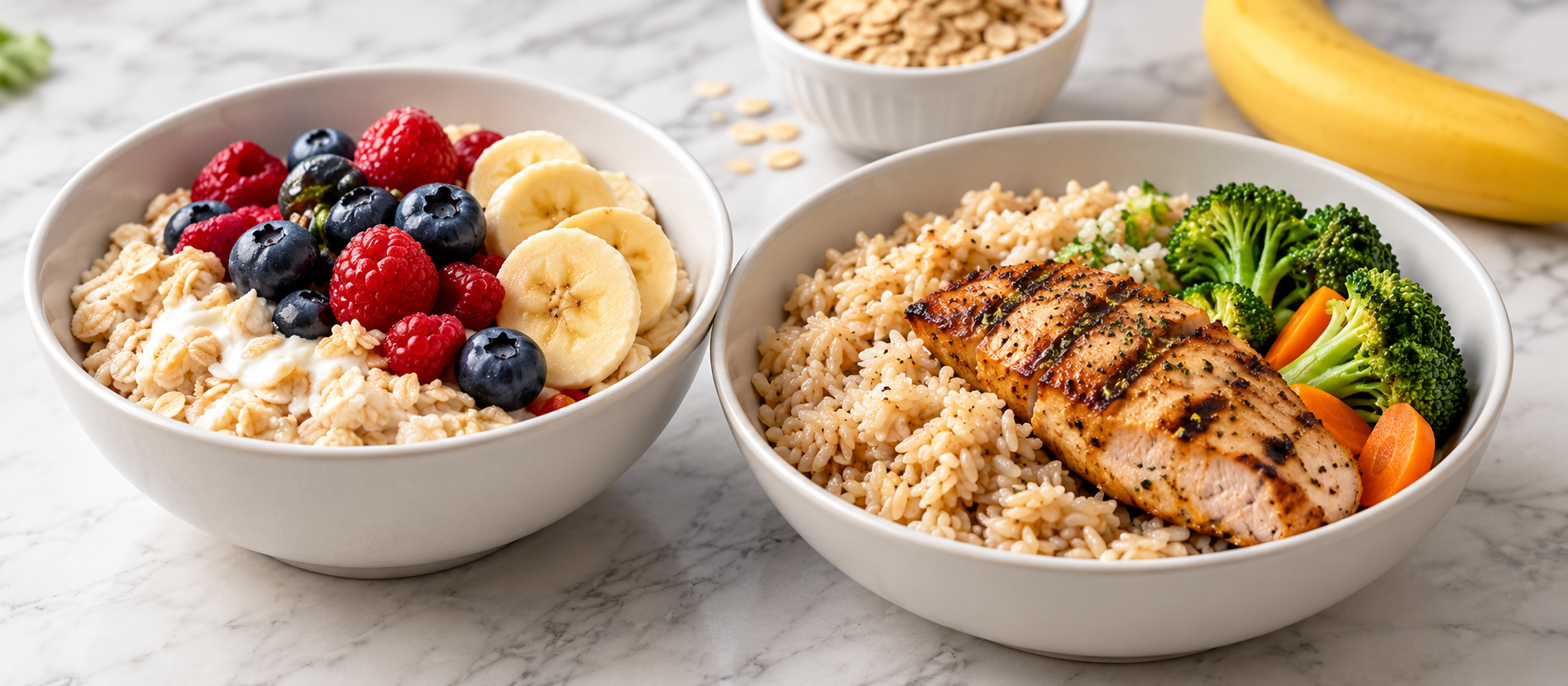
No. The pre-, during- and post-workout allocations are portions of your daily macro plan. The remaining-macros panel subtracts these allocations, so they are not added on top. Pictured meals are examples, not exact nutrient analyses or weighed recipes.
Sources & References
 ISSN · Nutrient timingPosition stand on nutrient timing and exercise.
 ACSM · Nutrition & performanceJoint nutrition and athletic performance statement.ISSN · Protein & exercisePosition stand on protein and exercise.
Sources inform the content. No institutional endorsement or individual clinical review is claimed. Planning presets and meal allocations are ST illustrations, not validated personal requirements. Sources checked 20 October 2026. Generated imagery is reused from the approved design.
Fuel the session. Balance the day. Time your nutrition.