Absolute Neutrophil Count Calculator
(ANC, without bands)
Estimate the absolute number of neutrophils from a complete blood count. Separately reported bands are excluded. Educational support only; interpret results with a qualified clinician.
Your ANC result
Interpret with your laboratory range and clinical context.
A percentage becomes an absolute count
55 of every 100 white blood cells are neutrophils.
This does not establish normal immunity or treatment eligibility.
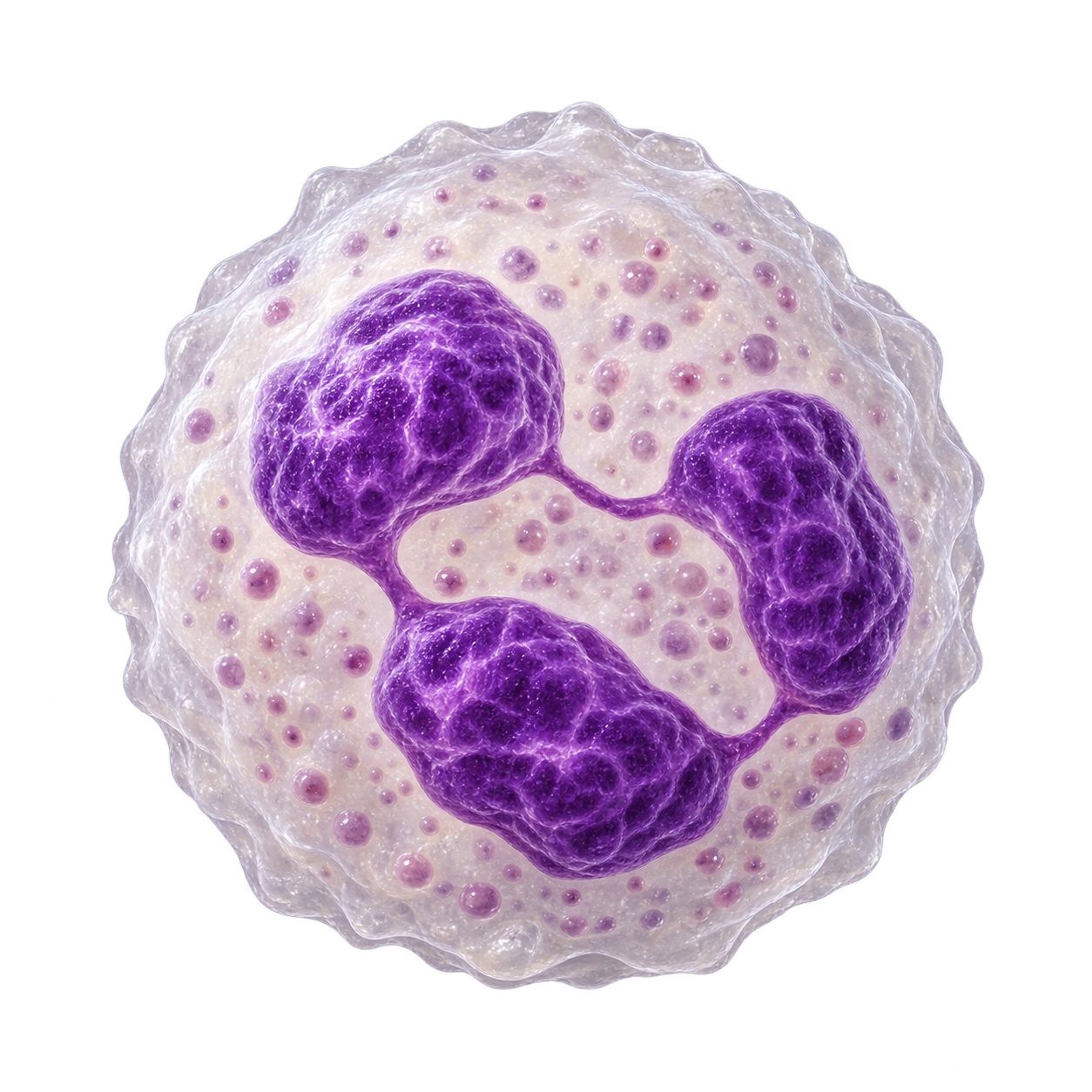 Illustration · not a patient sample
Why the absolute count matters
The same neutrophil percentage can mean very different counts.


Neutropenia reference ranges
| ANC (cells/μL) | Interpretation |
|---|---|
| ≥1,500 | No neutropenia by common adult cutoffs |
| 1,000–1,499 | Mild neutropenia |
| 500–999 | Moderate neutropenia |
| <500 | Severe neutropenia |
| <100 | Profound neutropenia (subset of severe) |
Displayed ranges assume whole cells. Exact cutoffs: mild ≥1,000 and <1,500; moderate ≥500 and <1,000; severe <500. Classification uses the unrounded result.
Risk also depends on duration, treatment and symptoms. Reference ranges vary with age, laboratory and individual baseline.
Clinical context
Read the complete blood count
Review WBC, differential and other cell lines.
Check symptoms and trends
Consider recent values, changes over time and clinical symptoms.
Use the treating team’s protocol
Follow the oncology team’s guidance for management and chemotherapy decisions.
ANC alone does not determine chemotherapy eligibility. An ANC above 1,500 is not a guarantee of normal immune function.
Formula & Worked Example
ANC = WBC × neutrophils (%) ÷ 100
6,000 × 55 ÷ 100 → ANC = 3,300 cells/μL
3,300 ÷ 1,000 = 3.30 ×10⁹/L
Understanding WBC unit conversions
1 cell/μL equals 1 cell/mm³. A WBC of 6.0 ×10⁹/L is numerically equal to 6.0 ×10³/μL; both mean 6,000 cells/μL. The calculator converts WBC to cells/μL before multiplying by the fraction of neutrophils.
Frequently Asked Questions
Does this calculator include bands?
No. It uses only the percentage you enter. A standard total ANC may include segmented neutrophils and separately reported bands. If the report lists bands separately, this without-bands result may underestimate the total ANC. Do not add bands twice when the laboratory already includes them in its neutrophil percentage.
What does a low ANC mean?
It indicates a reduced circulating neutrophil count by the stated cutoffs. It does not establish the cause or predict an individual’s infection risk on its own. A clinician considers duration, symptoms, treatment, baseline and laboratory ranges.
Can ANC decide treatment eligibility?
No. Chemotherapy thresholds differ by regimen, disease and clinical circumstances. Treatment decisions belong to the treating team. This calculator does not advise stopping or starting treatment.
Why is a percentage not enough?
A differential of 55% gives an ANC of 3,300/μL at WBC 6,000/μL, but only 440/μL at WBC 800/μL. The absolute count combines both measurements.
Is this calculator suitable for children?
The arithmetic is unchanged, but the displayed interpretation uses common adult cutoffs. Children need age-specific laboratory and clinical interpretation.
Sources & References
 Merck ManualNeutropenia overview and common severity categories.
Further context: ASCO / IDSA guidance describes profound neutropenia (<100/μL) and the importance of duration.
Independent sources, not institutional endorsement. No specialist review is claimed. Content basis checked 19 October 2026.
Calculate ANC without bands. Understand the absolute count and its clinical context.