

Bedridden Patient Height
Estimate stature when standing height cannot be measured.
Estimated stature
Within the original study age range · 60–90 years.
Measuring knee height
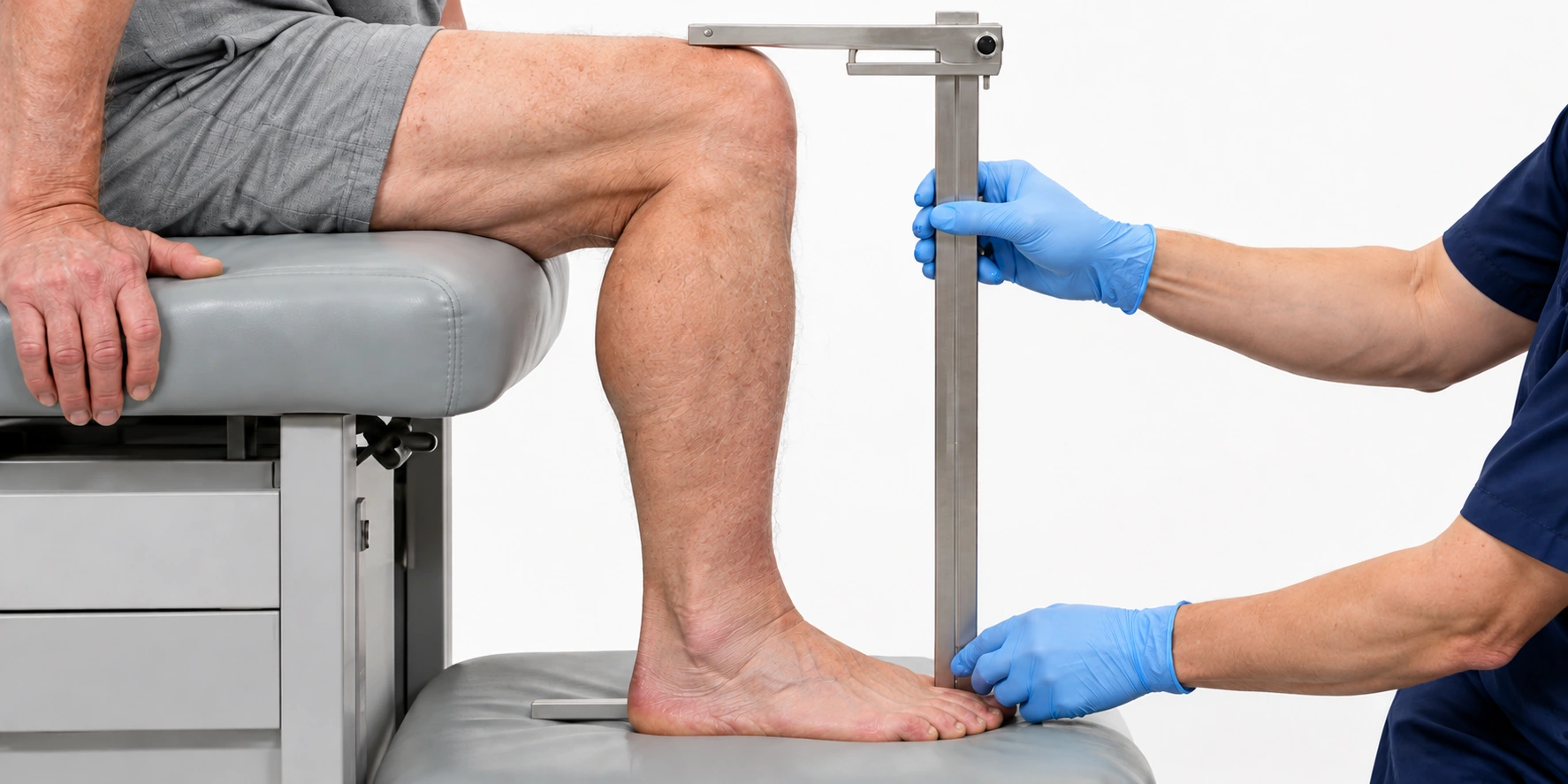


Illustrative positioning. The fixed caliper blade goes under the heel; the upper blade contacts the anterior thigh just above the knee. Both knee and ankle should be at 90°.
Using the estimated height
Use this estimate for other clinical calculations:
Carry this estimate forward, then review all patient inputs.
Calculation & assumptions
Male equation (Chumlea, 1985)
Height = 64.19 − 0.04 × age + 2.02 × knee height
Example (your values)
64.19 − 0.04 × 70 + 2.02 × 48 = 158.35 cm
Female equation (Chumlea, 1985)
Height = 84.88 − 0.24 × age + 1.83 × knee height
Original equations were derived in older white adults. Clinical fit cannot be confirmed by age alone. The knee-height input limits here are technical checks, not validated population bounds. Use another assessment when positioning, deformity or population differences make the method unsuitable.
Frequently asked questions
Who can use this equation?
This implementation uses the sex-specific Chumlea 1985 equations for ages 60–90. The original study involved white older adults. A clinician should judge whether the equation and measurement technique fit the patient. No extrapolated result is provided for ages outside this range.
How is knee height measured?
Use a suitable large sliding caliper. Position the knee and ankle at 90°. Place the fixed blade beneath the heel and the movable blade on the anterior thigh above the femoral condyles, proximal to the patella. Follow a standardized protocol; do not force restricted or painful joints.
Why is this an estimate?
The equation predicts stature from a body segment rather than directly measuring standing height. The original study reported approximately ±6 cm individual 90% error bounds. This is not a personalized confidence interval and may not describe another population.
Can I use it for dosing?
Do not use this estimate alone to determine a medication dose or ventilator setting. Height uncertainty can affect BMI, body surface area and predicted body weight. A qualified professional must review the method, patient factors and the relevant drug or ventilation protocol.
Sources & References
Geriatrics Society
1985 · Equations for ages 60–90.

NHANES knee-height procedure.
CLINICAL NUTRITION
Li et al., 2000. Study in older adults.
References inform the calculation; no institutional endorsement. Journal names identify the cited publications.
Estimate stature when standing height cannot be measured.