

Cell Dilution Calculator
Viable cell dilution & seeding planner
Vessel settings are editable volume examples, not cell-line recommendations.
Cell suspension inputs
Pipetting plan
Step-by-step solution
Volume breakdown

—
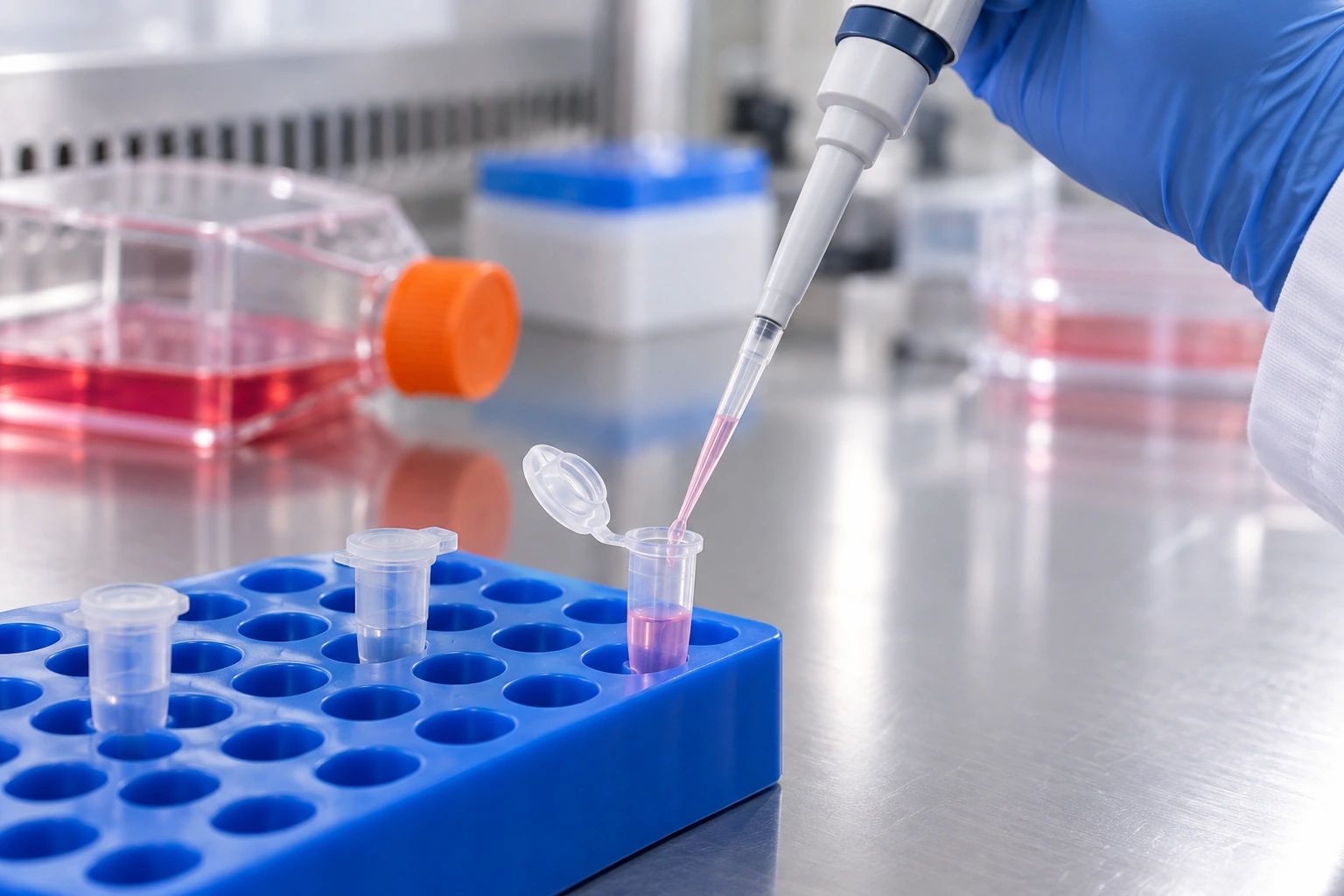
Illustrative labware; the bar shows planned volume fractions, not physical layers.
Preparation Summary
- Count basis
- Total cells
- Viability correction
- 92% · applied once
- Cell stock volume
- 0.200 mL
- Fresh media volume
- 0.800 mL
- Final viable density
- 276,000 cells/mL
- Batch volume / excess
- —
Check pipette range and available stock before preparing the suspension. Rounded volumes do not establish delivery accuracy.
Serial Step Breakdown
| Step | Viable cells/mL | Retained volume |
|---|
Retained volumes account for the next transfer; the last tube keeps its full volume.
Dilution alone cannot reach a higher concentration. Infeasible targets are flagged.
Three calculation workflows
Serial transfer & cell conservation
For a dilution factor F and final step volume V, each step receives V/F from its predecessor and V − V/F of fresh medium. Cᵢ = C₀/Fⁱ. A 1:5 dilution means one part transfer plus four parts medium.
Earlier tubes retain V − V/F after passing an aliquot forward; the last tube retains V. Do not add the full pre-transfer contents of every tube as if no cells moved. The sum of retained cells equals the original stock cells entering the series in this ideal model, assuming no growth, death or transfer losses.
Select serial mode to inspect the current cell balance.
Read the plan correctly
Count basis: total is not already viable
If the count includes non-viable cells, apply the measured viability once. Already viable counts need no second correction.
Concentration and volume are different quantities
Cells/mL is a concentration; μL and mL are volumes. 1 mL = 1,000 μL. Enter original stock concentration after any counting-assay dilution correction.
Check measurable volumes and model assumptions
Confirm instrument range, cell suspension homogeneity and your validated SOP. Arithmetic cannot predict clumping, attachment, growth, sterility or recovery.
Frequently asked questions
Total or viable stock concentration?
Select Total cells if the count includes live and dead cells; the entered viability percentage is then applied once. If your instrument already reports viable cells/mL, select Already viable and no viability multiplication is applied.
Does C₁V₁ = C₂V₂ apply to cells?
Yes. For a well-mixed suspension, cell number conservation gives concentration × volume. Use the same cell-count basis on both sides. This calculator targets viable cells and uses an effective viable stock concentration.
What if the target exceeds the stock?
Simple dilution cannot increase cell concentration. If the viable target density exceeds effective viable stock, the tool clears the volume plan and flags the target as infeasible. It does not prescribe a concentration procedure.
Are vessel volumes universal?
No. Vessel buttons load editable volume/count examples only. Follow the vessel manufacturer and cell-specific validated protocol. No universal seeding density, growth outcome or medium suitability is implied.
Show all questions (10 more)Show fewer questions
What does the Cell Dilution calculator calculate?
It calculates stock and media volumes from viable stock density and a target concentration, or from viable cells per vessel and final vessel volume. Serial mode computes repeated dilution transfers separately.
Which values should I enter?
Use original suspension concentration in cells/mL, count basis, viability when needed and a target viable count or density. Do not enter fresh-medium percentage as cell concentration. Enter the volume and vessel count appropriate for your experiment.
What formula does this calculator use?
For total-cell counts, effective stock C = measured C × viability/100. Dilution stock volume = target viable concentration × final volume / effective stock C. Media volume = final volume − stock volume. Seeding cells per vessel divided by vessel volume gives target viable concentration.
Why might my result differ from another source?
The other tool may use total cells rather than viable cells, a different counting dilution correction, batch excess or another volume unit. This tool keeps those assumptions explicit and retains unrounded intermediate values.
Does the result update automatically?
Yes. Modes, vessel examples, volume units and numeric inputs update the plan immediately. Invalid inputs clear volumes and disable copying. Unit changes convert the same physical volume.
How is preparation margin applied?
In seeding mode, the percentage adds proportional excess to total batch volume and viable cells. Concentration and per-vessel targets remain unchanged. The excess is prepared material, not additional cells actually seeded into the entered vessel count.
How does serial dilution work?
A factor of 5 means one part transfer plus four parts media: transfer volume = per-step final volume / 5. Each step receives a well-mixed aliquot from its predecessor. The step table shows concentration and retained volume after the next transfer. The last tube retains its full volume.
Do I need a hemocytometer dilution factor here?
Enter the concentration of the original stock suspension. If your count calculation or instrument already corrected for staining/counting dilution, do not multiply again. This module is not a raw hemocytometer-count calculator.
Are rounded volumes pipetting instructions?
Displayed rounding is for readability. Check pipette range, precision, mixing and your validated procedure; the diagram is not a calibrated tube or a physical layering prediction. Very small aliquots are flagged for review, without automatically changing the requested target.
What does the Cell Dilution calculate?
Calculate cell stock and media volumes from viable-cell concentration, seeding targets or a serial dilution factor.
Formula & worked example
Intermediate calculations retain full precision; displayed volumes are rounded.Sources & References


Sources inform the guide; no institutional endorsement.
Calculate cell stock and media volumes from viable-cell concentration, seeding targets or a serial dilution factor.