

Potato Yield Calculator
From seed pieces to harvest bags. Plan your potato crop.
Crop & Planting Inputs
RESULT
100 plants × 5 tubers × 6.4 oz
Russet Burbank · editable scenario
Below the Soil
Russet Burbank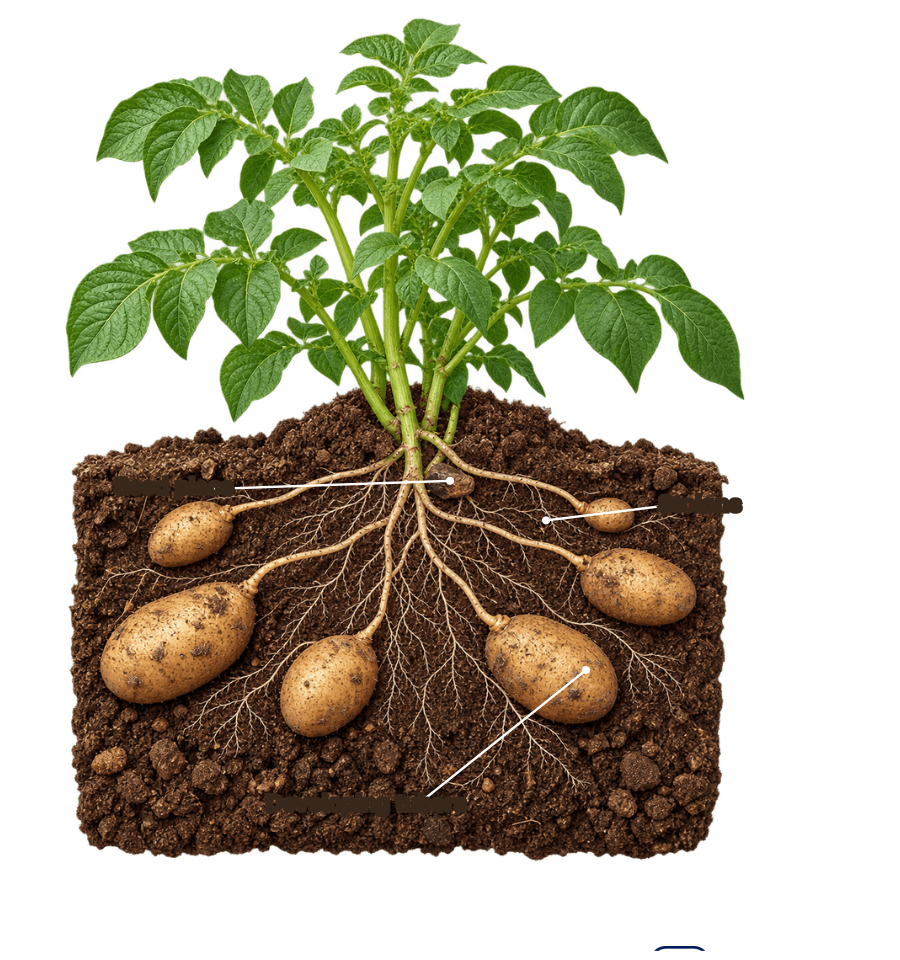
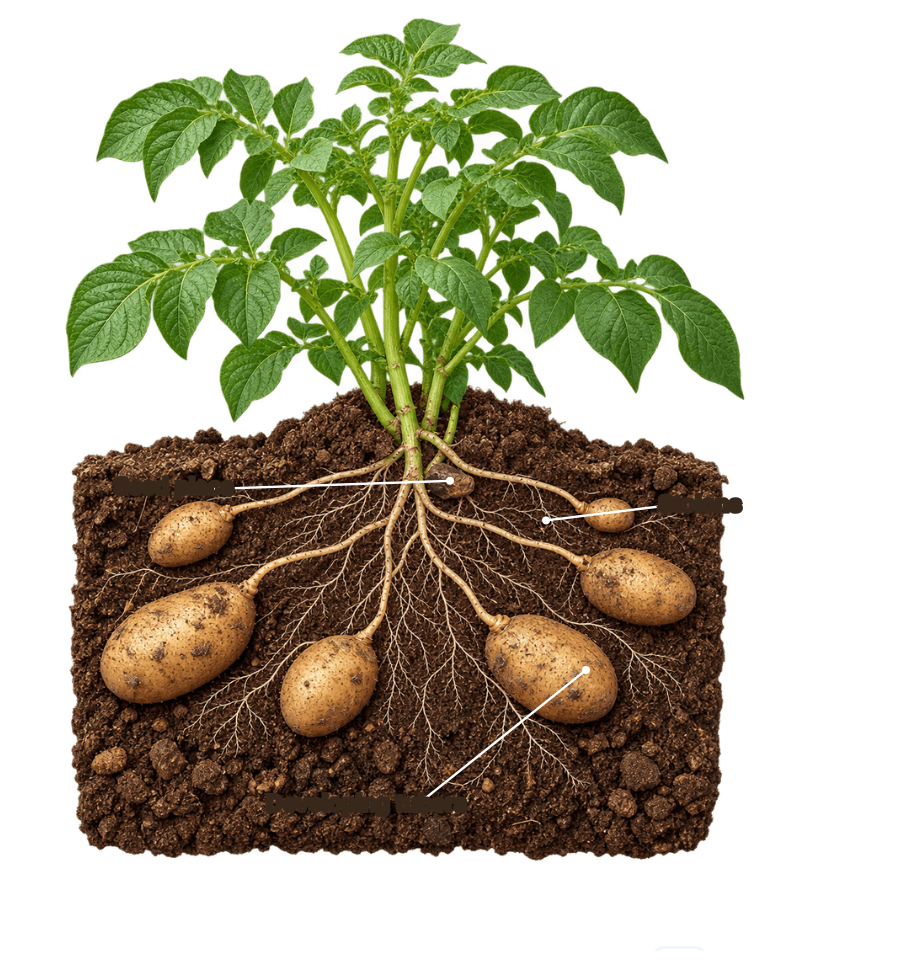
Illustrative crop section · not to scale. Tuber number and mature plant size are not depicted to match the calculated quantity.
Harvest Bag Equivalent
4 full bags × 50 lbNo remainder.
Equivalent capacity; grading, harvest and storage losses are not included.
Planning estimate — variety presets are editable scenarios. Actual yield depends on seed health, spacing, weather and management.
Calculation & Worked Example
Frequently Asked Questions
How is potato yield estimated?
Plants & Tubers mode multiplies planned planting positions by the expected establishment fraction, tubers per established plant and average tuber mass. Garden Rows first estimates planting positions from complete spacing cells in each row. Field Yield multiplies harvested area by your entered yield rate.
How many seed potatoes do I need?
The seed estimate is one plantable tuber or tuber piece per planned planting position. It is not a count of whole purchased potatoes: a larger seed tuber can supply several suitable pieces. Estimated seed mass is pieces times average piece mass, before any cutting or handling allowance.
Are the variety presets guaranteed yields?
No. Russet Burbank, Yukon Gold and Red Pontiac load editable tuber-number and mass examples. They are not validated variety-specific forecasts. Weather, seed health, irrigation, soil, spacing and harvest timing can substantially alter the result. Red Pontiac is not automatically a baby potato.
What changes in Garden Rows mode?
Positions per row = floor(row length / in-row spacing), using a half-spacing cell at either end. Multiply by the entered number of rows. Nominal allocated area = row length × row count × row spacing. This includes an allocated row-width strip, not a surveyed plot boundary.
More questions (8)
How is establishment applied?
It reduces the expected number of producing plants in Plants & Tubers and Garden Rows modes. For 100 planted pieces and 90% establishment, 90 producing plants are expected, but 100 seed pieces are still required. It is not a late-season tuber loss or marketable-grade adjustment.
Why is establishment hidden in Field Yield?
A harvested-area yield target already describes the expected crop mass. Applying establishment again could double-count losses. Field mode therefore uses area × yield directly. It estimates seed pieces separately from area and spacing and does not infer a tuber count or yield per plant.
How are field seed requirements estimated?
Field mode uses ceil(area / (row spacing × in-row spacing)) as an area-based purchasing estimate. It assumes the same area is planted and harvested and excludes headlands, paths and irregular boundaries. Use net planted area or a separate field plan when those differ.
What do t/ha and cwt/acre mean?
t/ha means metric tonnes per hectare. One tonne is 1,000 kg and one hectare is 10,000 m². This calculator uses US short hundredweight: 1 cwt = 100 lb, not the 112 lb imperial hundredweight. One acre is 4,046.8564224 m².
How are full and partial bags counted?
Full bags are the whole-number part of harvest mass divided by bag capacity. Any remaining mass is shown separately, with its percentage of one bag. The number of empty bags needed includes that last partial bag. Bags are capacity equivalents, not a prediction of saleable graded product.
Does changing units alter the harvest?
No. The physical values are retained internally. Pounds, ounces, kilograms and grams, and row lengths in feet/inches or meters/centimeters, are converted for display. Field area and yield-unit selectors also preserve the physical target when changed.
Does the illustration show my exact tuber count?
No. The crop section is conceptual and changes with the chosen variety. Tubers develop on underground stolons, which are stems, not roots. The drawing does not simulate water, nutrients, disease or tuber initiation. The sack illustration is capped at a small number; the numeric total remains authoritative.
Does this include harvest and storage losses?
No. The result is an expected fresh harvested mass under the assumptions you enter. Diseased, damaged, undersized, green or storage-lost potatoes can reduce usable mass. Use farm records for realistic tuber mass, establishment or a field yield target; the tool does not prescribe a local production program.
Sources & References


See also: University of Minnesota Extension potato growing guide. References provide context, not endorsement of the example yields.
Plan potato harvest, seed pieces and bag equivalents from plant counts, row spacing or a field yield target.