

Compost Calculator
Build a balanced recipe. Understand carbon, nitrogen and moisture.
Material library · Dry-matter C:N balance · Moisture & batch planning
Materials & Recipe
Result
Estimated mix C:N ratio
Enable JavaScriptEnter a recipe to calculate.
Volume uses editable bulk-density estimates; settling changes actual volume.
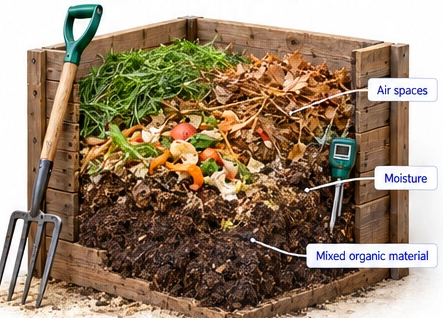
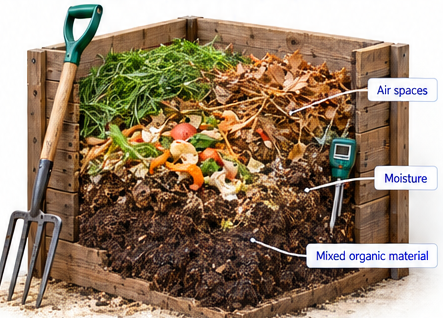


Carbon–Nitrogen & Moisture Balance
C:N ratio
Moisture content
Recipe Balancer
Check moisture after any material addition.
Water adjustment
Calculated after recipe entry.
Batch & Aeration Planner
General planning guide: often 3–8 months; conditions vary.
- Fresh mix
- Active composting
- Curing
- Mature compost
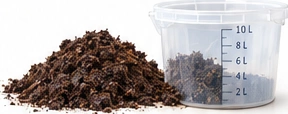
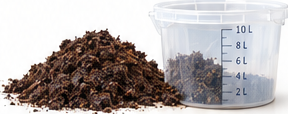
A small batch may not retain enough heat for hot composting.
Understanding your mix
- Account for dry matterC and N are calculated from the dry (non-water) fraction of each material.
- Balance total C and NThe mix C:N uses total carbon and total nitrogen, not an average of ingredient ratios.
- Adjust moisture and aerationStart around 50–60% moisture and maintain air spaces by mixing and suitable bulking material.
C:N = Σ[wet mass × dry fraction × C%] / Σ[wet mass × dry fraction × N%]
Targets, assumptions & material variability
This planner uses a selected starting C:N target band of 25–30 and a starting moisture band of 50–60%. They are planning targets, not universal pass/fail limits. Other systems may operate successfully across wider ranges.
Preset C, N, moisture and bulk-density values are illustrative estimates; no two feedstocks are identical. Carbon availability, lignin, particle size, porosity, weather and management influence actual decomposition. A good numeric ratio does not prove a safe or mature compost product.
Moisture is wet-basis water mass divided by total wet mass. Carbon and nitrogen percentages use dry matter. Input masses and volumes convert using 1 lb = 0.45359237 kg and 1 US gallon = 3.785411784 L. Loose ingredient volumes are added without predicting compaction or final yield.
Frequently asked questions
Why not average C:N ratios?
Each material contains different amounts of dry matter, carbon and nitrogen. Sum the actual estimated carbon and nitrogen masses separately, then divide total C by total N. If nitrogen is zero, the ratio is undefined.
Can I enter material volume?
Yes. Choose Loose volume and enter liters or US gallons. Check each material’s loose bulk density under assumptions. A liter of leaves and a liter of wet food scraps do not weigh the same. The displayed volume is a loose input estimate, not final compost output.
How much water should I add?
If the mixture is below the selected 50–60% band, the planner estimates water addition to 55% assuming water density of 1 kg/L. For a wet mixture, it estimates a separate dry-material scenario if the selected adjustment material is drier than 55%. Recheck C:N and aeration. Drainage and nutrient losses are not modeled.
When is compost ready?
Calendar ranges are broad management guides. Mature compost generally becomes dark, crumbly and earthy, with reduced biological activity. Check stability and suitability for its intended use; this calculator does not measure maturity, validate pathogen reduction or certify a sanitation process.
Which materials should I avoid at home?
Avoid pet waste, treated or painted wood, and contaminated feedstocks. Meat, fish, dairy and fats can cause pest and odor problems in basic household composting systems. Follow local guidance, especially for manures and food-growing applications.
Sources & References
 FAO — On-farm composting methodsComposting conditions, C:N and moisture guidance.
 USDA NRCS — Composting principlesUrban agriculture and compost management.
 Cornell Composting — C:N & moistureMaterial mass balance and recipe calculations.
Planning estimates, not a laboratory analysis. Material properties and composting conditions vary. Reference logos identify sources, not endorsement.
Build a balanced recipe. Understand carbon, nitrogen and moisture.