Fat Mass Index (FMI) Calculator
Calculate height-normalized fat mass from body fat percentage or a known fat mass, with a transparent breakdown of FMI, FFMI and BMI.
Calculation inputs
Start with a documented fat measurement
- 1Choose your data source
Select body fat percentage or known fat mass from a body-composition report.
- 2Keep height and mass units clear
The calculation converts to kilograms and metres before dividing by height squared.
- 3Keep the components separate
FMI tracks fat mass; FFMI tracks the fat-free remainder. Neither is a direct muscle measurement.
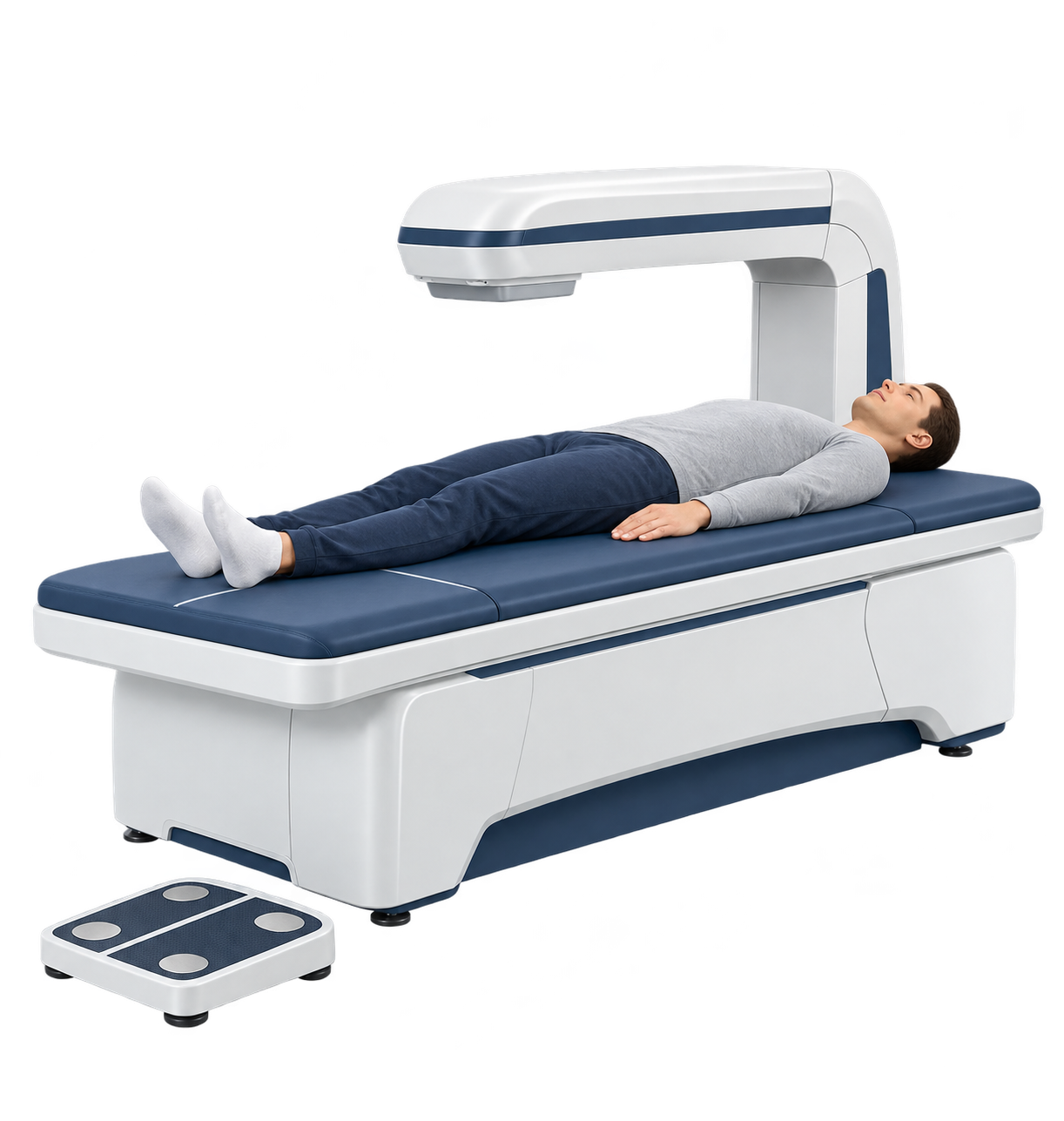
Measurement and method sources are linked below. Illustrations explain the workflow; they do not supply measurement data.
Explore the calculation model
Body mass components

Calculation results
Step-by-step solution
Choose the formula
Substitute your measurements
Calculate in order
Write the result
Separate fat mass from total body weight.
- 1Find the fat component
75 kg × 20% = 15 kg
- 2Normalize to the same height
1.75 m × 1.75 m = 3.0625 m²
- 3Check the mass decomposition
FMI 4.9 + FFMI 19.59 ≈ BMI 24.49
The components add up to your entered weight. The fat-free remainder includes water, bone and organs as well as muscle.
FMI inherits any error in the entered fat measurement. No universal healthy range or diagnosis is assigned here.
Measurements & calculation details
| Quantity | Value |
|---|---|
| Height squared | 3.0625 m² |
| Fat mass | 15 kg |
| Fat-free remainder | 60 kg |
| FMI | 4.897959 kg/m² |
| FFMI | 19.591837 kg/m² |
| BMI = FMI + FFMI | 24.489796 kg/m² |
Try a worked example
Choose an example to load its measurements into the calculator. Each result uses the same calculation engine as your own inputs. Back to your calculation
Understand the calculation
Concept & meaning
FMI isolates the fat component of weight and divides it by height squared. BMI uses total weight; it cannot distinguish fat from the fat-free remainder. This page uses the same height for all three indices.
Formula & special cases
If body fat is p%, fat mass = weight × p/100. The remainder = weight − fat mass; FFMI = remainder / height². Algebraically FMI + FFMI = BMI, apart from display rounding. Body weight is also entered in known-fat-mass mode to check the measurement and produce this decomposition.
Scope & limitations
The 2009 NHANES paper proposed sex-specific FMI reference classifications from prevalence matching in young adults. Those research bands are not universal diagnostic thresholds, so this tool shows the numerical result without a healthy/unhealthy label.
Result from your current inputs
Fat Mass Index: 4.9 kg/m²
One height, three different numerators
| Calculation | Formula | Interpretation |
|---|---|---|
| FMI | Fat mass / height² | Fat component |
| FFMI | Fat-free remainder / height² | All non-fat components in the two-component model |
| BMI | Total weight / height² | Sum of FMI and FFMI |
Sources & References
 Kelly, Wilson & Heymsfield · 2009NHANES DXA study · fat mass divided by height squaredRead the reference
 NIDDK · adult weight managementIndividualized goals and adult health contextRead the reference
References document the methods and their limitations; links and logos do not imply institutional endorsement or expert review.