Ponderal Index Calculator
Calculate weight divided by height cubed, compare its units with BMI, and explore how height normalization changes the result.
Calculation inputs
Height is used three times
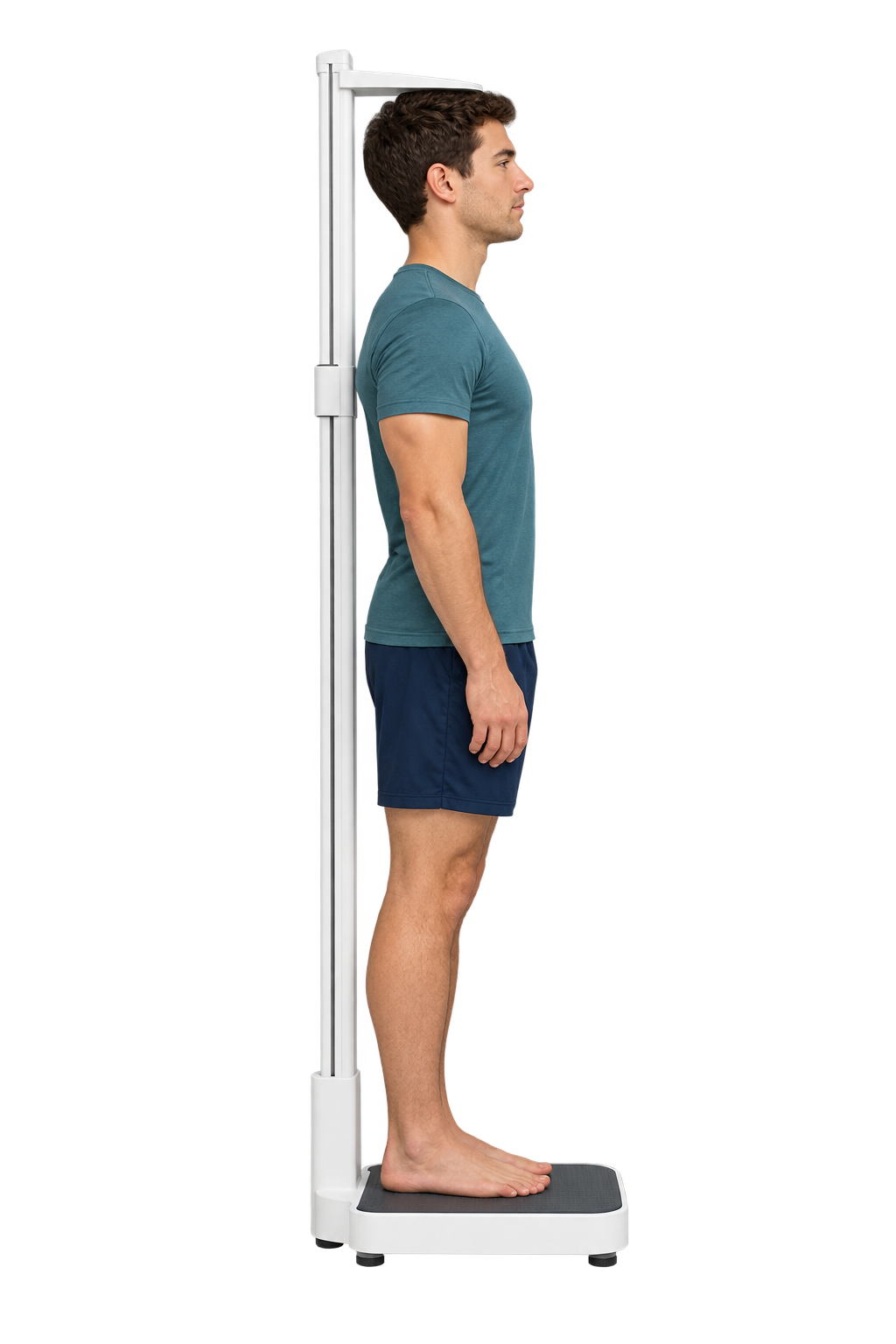
- 1Measure standing height
Use adult standing height without shoes. This page is not a newborn or pediatric assessment.
- 2Convert before cubing
175 cm becomes 1.75 m. Its cube is 5.359375 m³, not 175³ in the same unit.
- 3Read the correct units
PI uses kg/m³; BMI uses kg/m². Their numbers and thresholds are not interchangeable.
Measurement and method sources are linked below. Illustrations explain the workflow; they do not supply measurement data.
Explore the height sensitivity chart
Height normalization · fixed weight

Calculation results
Step-by-step solution
Choose the formula
Substitute your measurements
Calculate in order
Write the result
See what cubing height really changes.
- 1Convert height to metres
175 cm ÷ 100 = 1.75 m
- 2Use height three times
1.75 × 1.75 × 1.75 = 5.359375 m³
- 3Keep BMI and PI separate
PI 13.994 kg/m³ · BMI 24.49 kg/m²
The sensitivity chart holds weight fixed. It illustrates a mathematical relationship, not future growth or a clinical healthy range.
This adult calculation uses kg/m³. It is not the newborn g/cm³ × 100 convention and does not assign a clinical healthy range.
Measurements & calculation details
| Quantity | Value |
|---|---|
| Height | 1.75 m |
| Height² | 3.0625 m² |
| Height³ | 5.359375 m³ |
| Ponderal Index | 13.994169 kg/m³ |
| BMI (different units) | 24.489796 kg/m² |
Try a worked example
Choose an example to load its measurements into the calculator. Each result uses the same calculation engine as your own inputs. Back to your calculation
Understand the calculation
Concept & meaning
The Ponderal Index scales mass by height cubed, unlike BMI, which scales mass by height squared. It is also called a tri-ponderal mass index in research. Because units differ, a PI number cannot be compared directly with a BMI threshold.
Formula & special cases
Convert height to metres first, then multiply it by itself three times. PI = W/H³ and BMI = W/H². At the same weight, greater height produces a smaller PI. The curve holds weight fixed and varies only height; it is a mathematical sensitivity plot, not a prediction of growth.
Scope & limitations
Research such as Peterson et al. (2017) studied tri-ponderal mass index in specific adolescent populations. It does not supply a universal adult diagnostic range. Neonatal conventions use different scaling; this adult kg/m³ page must not be used with newborn reference tables.
Result from your current inputs
Ponderal Index: 13.994 kg/m³
Keep the indices and units separate
| Calculation | Formula | Interpretation |
|---|---|---|
| Ponderal Index | W / H³ | kg/m³ |
| BMI | W / H² | kg/m² |
| Chart | Weight fixed; height varied | Mathematical sensitivity only |
Sources & References
 Peterson et al. · 2017Weight / height³ research · adolescent population, not an adult cutoffRead the reference
 NHLBI · BMI for contextBMI uses height squared, with different unitsRead the reference
References document the methods and their limitations; links and logos do not imply institutional endorsement or expert review.