

Ideal Body Fat Percentage Calculator
See how a chosen body-fat percentage divides your weight into fat and fat-free mass.
User-selected percentage · Two-component model · Educational estimate
Your inputs
Your composition
fat mass
Step-by-step solution
One weight. Two components.
Fat mass
Fat-free mass
Fat-free mass includes muscle, bone, organs and water.
A chosen percentage is not a diagnosis
The result models your inputs. It does not identify your personal ideal body-fat percentage.
Understand the number behind the percentage
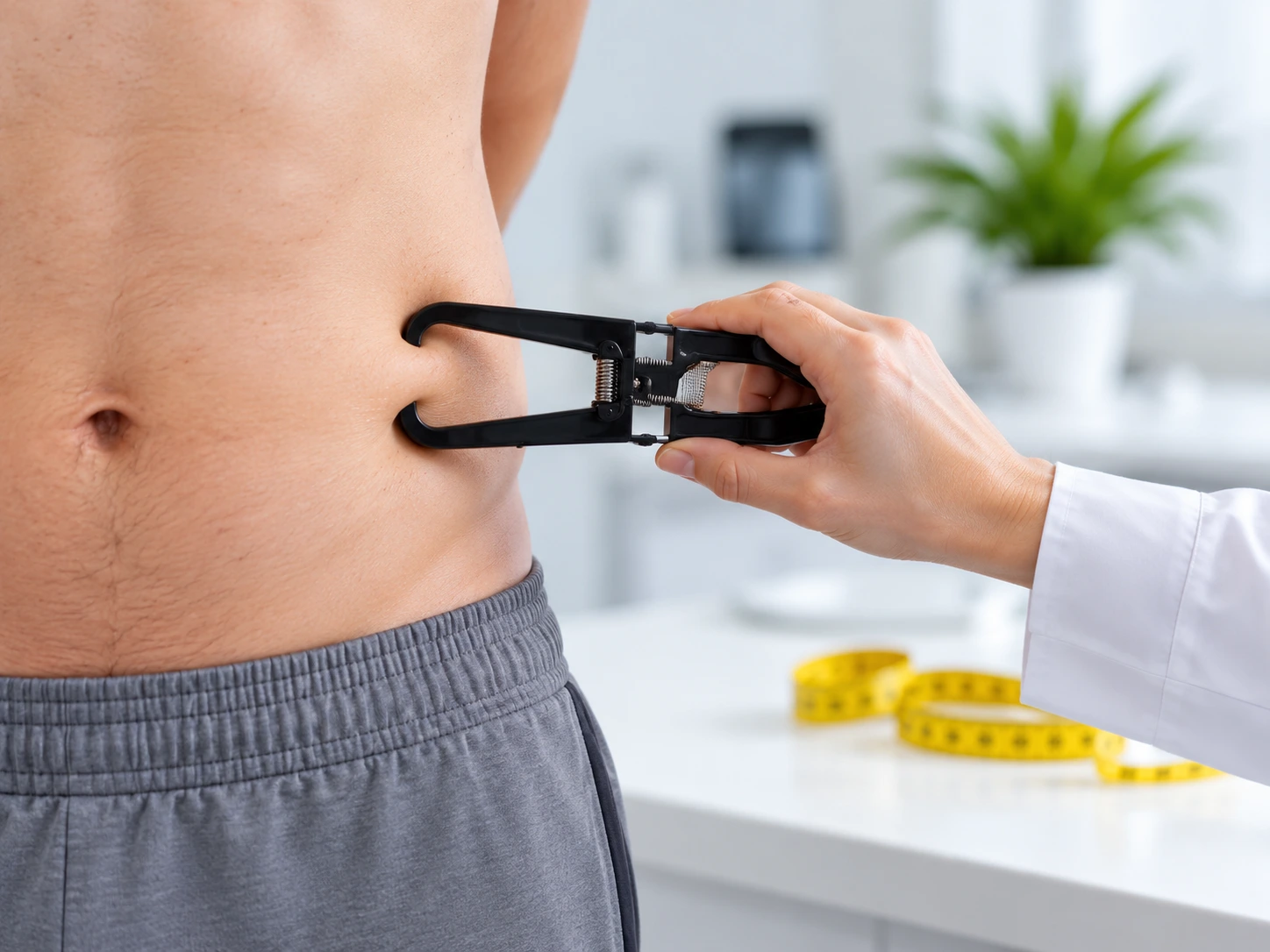

Fat mass
The portion of total weight represented by the percentage you enter.
Fat-free mass
Everything else in this two-component model—not just muscle.
Fat mass = body weight × body-fat % / 100
Calculation & assumptions
From percentage to mass
75 × 18 / 100 = 13.5 kg fat mass
75 − 13.5 = 61.5 kg fat-free mass
Changing the percentage
At the same body weight, the two components always add up to the total. This does not predict a different target weight.
Reading the result
The percentage is an input, not a measurement or an age-based recommendation. The example 18% is not a recommendation.
Units & input checks
1 lb = 0.45359237 kg. Inputs accept 0.5–1,000 kg and 0–100% as mathematical limits, not health recommendations. The slider covers 0–50%; larger percentages can be typed directly.
Frequently asked questions
What does “ideal” mean here?
You choose the percentage. This calculator shows the corresponding mass split; it does not identify a personal ideal percentage.
Does this measure my body fat?
No. Body weight and a chosen percentage describe a hypothetical composition. A measurement or validated assessment method is needed to estimate your current body fat.
Is fat-free mass the same as muscle?
No. Fat-free mass includes muscle, bone, organs, water and other components besides fat.
What does the Ideal Body Fat Percentage calculate?
Fat mass equals body weight multiplied by the chosen percentage divided by 100. Fat-free mass is the remaining weight.
Which values should I enter?
Enter body weight in kg or lb and the body-fat percentage you want to explore. The initial 75 kg and 18% are an example, not a recommendation.
What formula does this calculator use?
FM = W × p / 100; FFM = W − FM. The calculation does not use age- or sex-based reference tables.
More questions (5)
Why might my result differ from another source?
Check the entered weight, percentage, units, rounding and measurement method. This calculator models the percentage you provide.
Can I use this for medical decisions?
Use the calculation as educational context and discuss personal body-composition goals with a qualified healthcare professional.
Does this predict my target weight?
No. Both components here add up to the weight you enter. Predicting a different body weight requires additional assumptions.
Why is the slider limited to 50%?
The slider is a convenient visual control. You can enter any percentage between 0 and 100 directly. These mathematical limits are not healthy-range recommendations.
Does the result update automatically?
Yes. Changing an input updates the result using the same calculation engine shown on this page.
Sources & References
 Body composition & measurementBody components and methods used to assess them.
ACEUnderstanding body compositionContext for fat mass and body-fat percentages.
 Interpreting body-fat percentagesHuman Performance Resources by CHAMP.
References provide context, not endorsement. No institutional certification or expert review is claimed.
Page information
Updated: October 26, 2026
Educational estimate. Discuss personal weight goals with a qualified healthcare professional.