

Water Soluble Fertilizer Calculator
Mix precisely. Understand every nutrient.
Mixing Inputs
Mix Summary
For 20.0 L of final solution
Nutrient mass in this batch
Elemental nutrients added
P₂O₅ and K₂O converted to elemental P and K. Contributions from this fertilizer only; source-water nutrients are not included. Here “ppm” denotes dilute-solution mg/L.
Stock & Final Solution
Check product-specific solubility at the mixing temperature. No saturation or compatibility prediction is made.
EC requires product-specific data or measurement.
Fertigation Mixing Visualizer
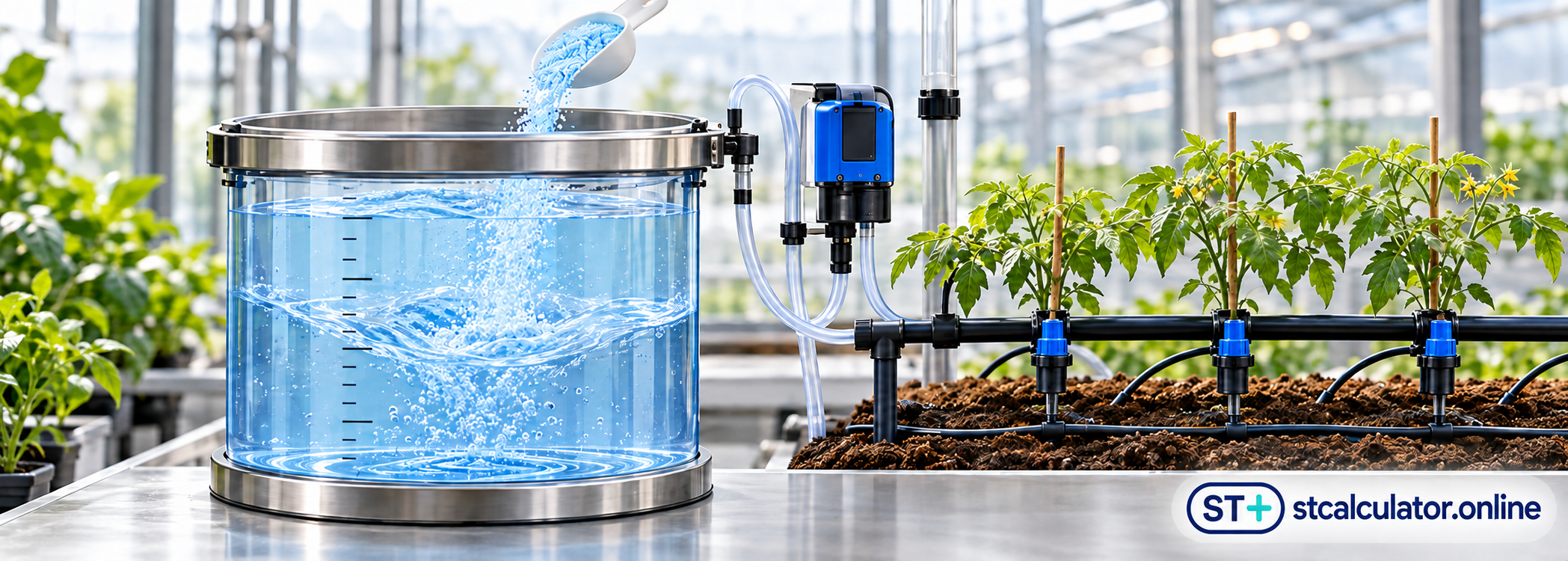 30.0 g fertilizer20.0 L final solutionDirect mixOptional injector mode
Illustrative equipment layout · Dissolve and make up to final volume. Color and liquid level do not measure concentration or solubility.
Check the product label, solubility and injector calibration.
Calculation & Worked Example
Elemental conversion factors: P = P₂O₅ × 0.4364268; K = K₂O × 0.8301498. These convert label equivalents, not additional ingredients.
Frequently Asked Questions
What does N-P-K mean?
The conventional fertilizer grade lists mass percentages of nitrogen (N), phosphate equivalent (P₂O₅) and potash equivalent (K₂O). For example, 20-20-20 supplies 20 g of each label nutrient per 100 g of fertilizer. The phosphorus and potassium figures are not elemental P and K; this tool also converts them to elemental amounts in the final solution.
Is nutrient ppm the same as fertilizer ppm?
No. A dose of 1 g fertilizer per liter is 1000 mg fertilizer/L. A 20% N fertilizer at that dose adds 200 mg N/L. In this tool, target N ppm means added mg N/L under the common dilute aqueous-solution convention. Strict mass-based ppm is mg/kg and depends on solution density.
How does injector dilution work?
The tool defines 1:R as one volume of stock diluted to R volumes of final solution. Stock concentration is the desired final fertilizer dose times R. Multiply that concentration by stock tank volume to find fertilizer mass. Manufacturer ratios may instead reference carrier-water volume; verify the definition and calibrate the injector.
Can this tool determine EC?
No. EC depends on fertilizer composition, concentration, temperature and source-water conductivity. Different fertilizers can produce different EC at the same nitrogen concentration. Use a calibrated EC meter or product-specific label data; the artwork color is decorative.
More questions (8)
Which volume should I enter?
In Direct Tank mode enter the final prepared solution volume. In Stock + Injector mode enter the final volume of concentrated stock solution. Dissolve the weighed fertilizer in part of the water, then make up to the intended volume, subject to product instructions. The tool does not model volume displacement.
How is the basic fertilizer mass calculated?
For direct mixing, fertilizer mass in grams equals final liters times dose in g/L. A 20 L final batch at 1.5 g/L requires 30 g. This is preparation arithmetic based on your chosen dose, not a crop-specific dose recommendation.
How do I calculate from target nitrogen?
Fertilizer dose (g/L) = target added N (mg/L) divided by [10 × label N (%)]. For 150 mg N/L and 20% N, dose is 0.75 g fertilizer/L. Target-N mode requires a fertilizer with nitrogen above zero. Other nutrients are co-supplied according to the grade.
Are water nutrients and other fertilizers included?
No. Results show only the entered fertilizer contribution. Source water, other stock tanks, acids and previous nutrient additions can change total nutrient concentrations. A complete fertigation program requires their contributions and the plant's requirements to be evaluated together.
Can I use any soluble product in one stock tank?
No. Solubility varies by product and temperature. Some concentrated combinations precipitate; for example, concentrated calcium salts can be incompatible with phosphate or sulfate salts. Follow the product's mixing instructions and compatibility guidance. This calculator does not predict chemical compatibility or dissolution time.
Are the presets crop recommendations?
No. The presets are example fertilizer grades for comparing mass balances. They do not establish suitability, optimum dose, crop response or completeness of nutrition. Check the actual guaranteed analysis, including nitrogen forms and micronutrients, and use crop and water-test guidance.
How do gallons and unit switches work?
The gallon option is US liquid gallons: 1 US gal = 3.785411784 L. Switching volume units converts the entered physical volume. Switching between g/L and target N converts the current dose using the current N percentage. Switching injector notation converts between R and 100/R percent.
What changes when I edit the inputs?
Valid edits recalculate fertilizer mass, label nutrient masses, final elemental concentrations and the figure's labels. Reset restores 20 L, 1.5 g/L and 20-20-20. Copy exports the current valid summary. The equipment image is illustrative and does not infer measured EC, tank capacity or dissolved fraction.
Sources & References
 Nutrient solution calculationsFertilizer grades, ppm and injector ratios
 Plant Nutrition Bulletin 16Plant nutrition for food security
Educational preparation arithmetic · Institutional references do not imply endorsement.
Calculate soluble fertilizer mass for direct tank mixing or stock-and-injector dilution, with N-P2O5-K2O and elemental nutrient breakdowns.