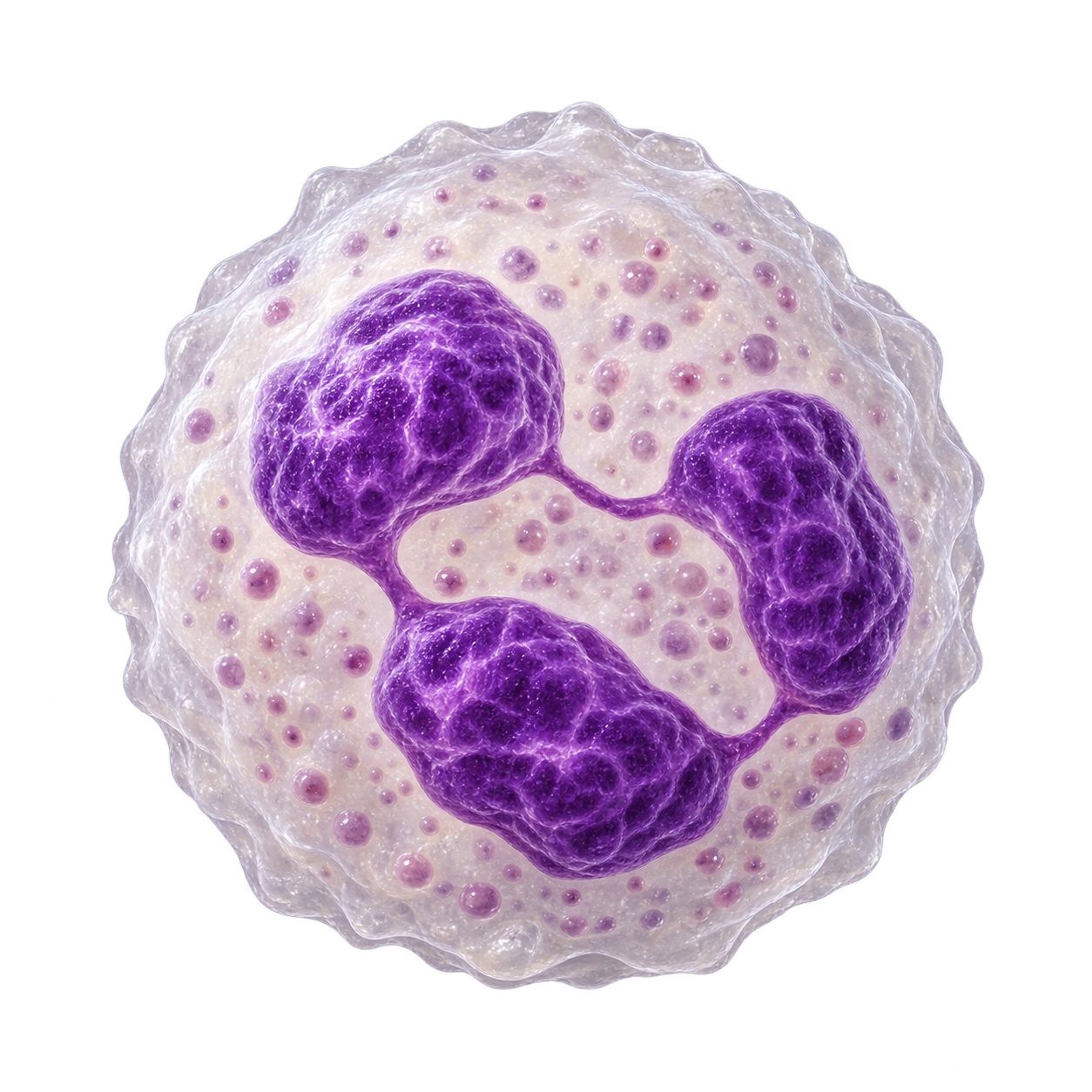
Segmented neutrophil
Mature · multi-lobed nucleus
(ANC, with bands)
Estimate the absolute number of neutrophils from segmented neutrophils and separately reported bands. Educational support only; interpret results with a qualified clinician.
Interpret with your laboratory range and clinical context.
55% segmented + 5% bands = 60% of WBC.
This does not establish normal immunity or treatment eligibility.
Mature · multi-lobed nucleus
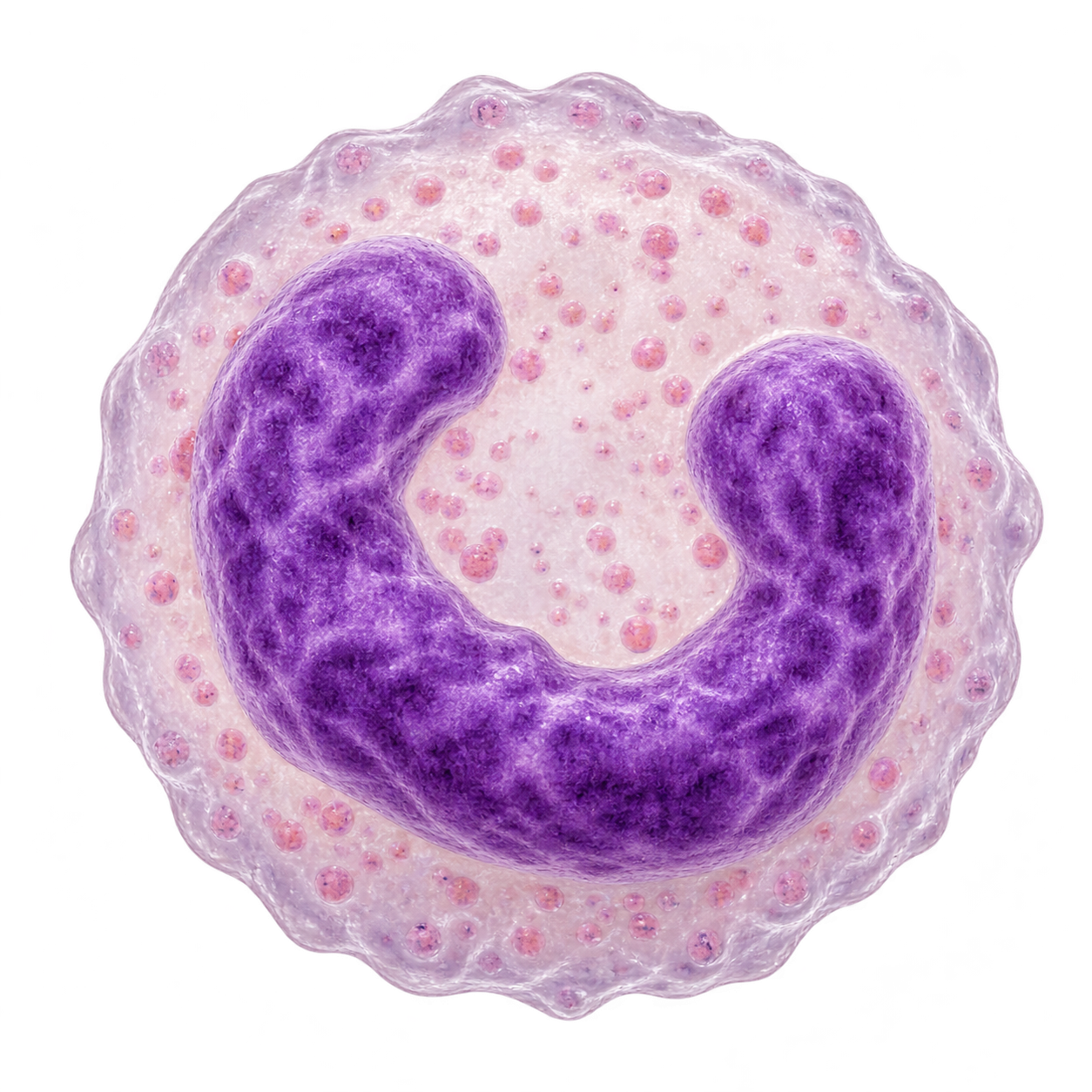
Less mature · continuous U/C-shaped nucleus
Bands are one immature neutrophil form; do not substitute the entire immature-granulocyte percentage. A band percentage alone does not diagnose an infection.


| ANC (cells/μL) | Interpretation |
|---|---|
| ≥1,500 | No neutropenia by common adult cutoffs |
| 1,000–1,499 | Mild neutropenia |
| 500–999 | Moderate neutropenia |
| <500 | Severe neutropenia |
| <100 | Profound neutropenia (subset of severe) |
Displayed ranges assume whole cells. Exact cutoffs: mild ≥1,000 and <1,500; moderate ≥500 and <1,000; severe <500. Classification uses the unrounded result.
Risk also depends on duration, treatment and symptoms. Reference ranges vary with age, laboratory and individual baseline.
Verify that segmented neutrophils and bands are reported separately on your laboratory report.
Consider recent values, changes over time and clinical symptoms.
Follow the oncology team’s guidance for management and chemotherapy decisions.
ANC alone does not determine chemotherapy eligibility. An ANC above 1,500 is not a guarantee of normal immune function.
Segmented % + bands % = 55% + 5% = 60%
6,000 × (55 + 5) ÷ 100 → ANC = 3,600 cells/μL
3,600 ÷ 1,000 = 3.60 ×10⁹/L
1 cell/μL equals 1 cell/mm³. A WBC of 6.0 ×10⁹/L is numerically equal to 6.0 ×10³/μL; both mean 6,000 cells/μL. The calculator converts WBC to cells/μL before multiplying by the combined segmented-plus-band fraction.
Do not add them again. This version expects segmented and band percentages to be reported separately. Use the single-percentage calculator with the combined percentage, or ask the laboratory to clarify its differential definition. The checkbox above blocks this separate-component calculation if your percentage already includes bands.
No. A laboratory’s immature-granulocyte (IG) percentage may refer to other stages such as metamyelocytes, myelocytes and promyelocytes, and its definition can vary by analyzer. Do not use the entire IG percentage as a band percentage. Confirm the report with the laboratory. Analyzer terminology reference.
No. Regimen, disease, symptoms, count trends and the treating team’s protocol determine management. This calculator does not advise starting or stopping treatment.
Yes, if the laboratory has reported zero bands. A blank or unreported band count is not automatically zero. If bands are unavailable, clarify the differential or use the without-bands tool with its stated limitation.
A reduced count needs interpretation with the laboratory range, individual baseline, duration and clinical circumstances. The common adult categories shown here are not a diagnosis. Children need age-specific interpretation.
 Merck ManualNeutropenia overview and common severity categories.
Formula reference: Oncology Nursing Society · ANC calculation.
Further context: ASCO / IDSA guidance describes profound neutropenia (<100/μL) and the importance of duration.
Independent sources, not institutional endorsement. No specialist review is claimed. Content basis checked 19 October 2026.
Calculate ANC with separately reported bands. See how mature and band cells contribute.